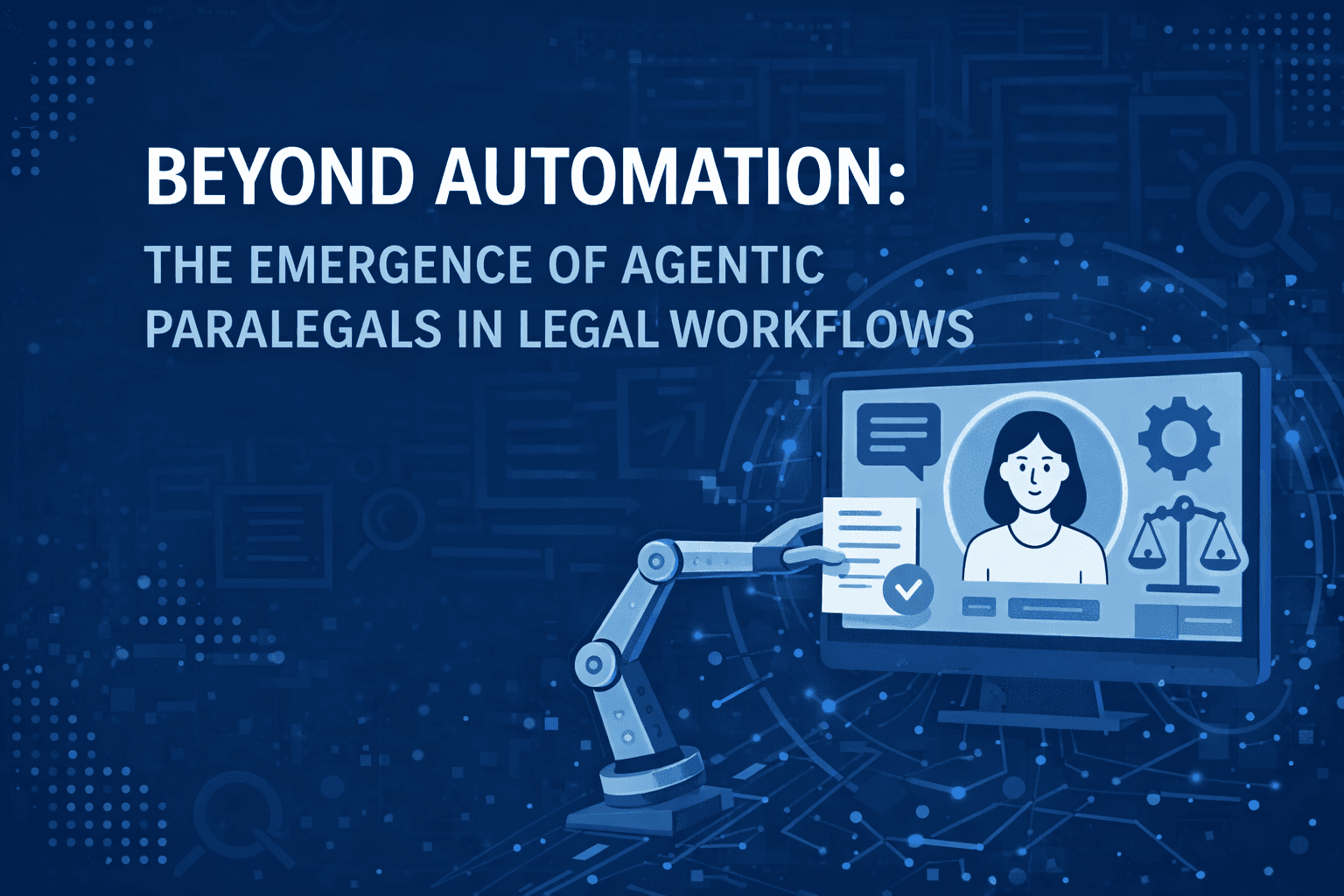
Beyond Automation: The Emergence of Agentic Paralegals in Legal Workflows
From Overload to Efficiency: The 240-Hour Advantage Lawyers Can’t Ignore
Imagine saving 240 hours per lawyer each year — more than six full work-weeks now freed for strategic client work and relationship building. According to the 2025 Thomson Reuters Future of Professionals Report, legal professionals using AI tools expect to recapture roughly this amount of time through automation of routine tasks. For individual lawyers, this isn’t just efficiency—it’s urgency. The competitive edge is shifting rapidly. If your workflow still relies on manual, repetitive tasks, you risk falling behind. The rise of “agentic paralegals”—AI-augmented, highly automated support systems—is rewriting what legal workflows can look like.
The Story of Change
In February 2023, Allen & Overy, one of the world’s largest law firms, became the first to integrate a generative AI assistant called Harvey AI—built on OpenAI’s GPT platform—across its global offices. More than 3,500 lawyers and paralegals began using Harvey to assist with drafting contracts, performing due diligence, and reviewing regulatory documents. Within months, the firm reported significant time savings on first-draft preparation and routine compliance checks, allowing lawyers to dedicate more time to client strategy and complex advisory work.
This transformation mirrors a larger movement sweeping through the profession. Across firms of all sizes—including solo and small practices—AI-driven “agentic paralegals” are emerging as digital co-workers, automating everything from document formatting and citation management to deadline tracking. Human paralegals, meanwhile, are taking on higher-order roles: legal research, substantive drafting, and final compliance review.
The result is a dual-layer model reshaping modern legal support—agentic paralegal systems handle repetitive, time-intensive work with precision, while human paralegals apply judgment, analytical skill, and oversight. For individual lawyers, adapting to this hybrid approach is no longer optional; it’s the key to remaining efficient, compliant, and competitive in 2025’s fast-evolving legal ecosystem.
The New Landscape of Agentic Paralegals in Legal Workflows
AI adoption in legal workflows is now both broad and measurable. According to the Thomson Reuters 2025 findings, most legal professionals report using AI for document review, legal research, and drafting assistance, with measurable time savings reported across firms. Likewise, the 2024 Clio Legal Trends Report found that a large share of paralegal billable work—such as form preparation, document drafting, and basic research—can be automated. Together, these findings confirm that agentic paralegal workflows are no longer experimental; they are a defining feature of modern legal practice.
Time, Templates, and Tedium: The Workflow Woes Holding Lawyers Back
- Excess formatting, citation, alignment work:Lawyers spend too much time editing drafts and customizing templates.
- Inconsistent compliance with court and attorney rules: Document formatting (fonts, spacing, hyperlinks, exhibits) takes time and invites error.
- Slow turnarounds and reduced billable client time:Manual workflows eat into strategic, client-oriented hours.
Actionable insights
- Benchmark your current support time:Track hours spent on document formatting, citations, and repetitive tasks over a month.
- Set a goal:For example, reduce non-billable drafting/formatting time by 30 % in 90 days using hybrid support.
- Map the workflow: Identify tasks that could be shifted to an automated “agentic paralegal” system (e.g., first-draft creation, auto-formatting, citation insertion, hyperlinking).
- Implement oversight protocols:Ensure any AI‐generated draft is reviewed by a human paralegal for legal compliance and firm standards.
With those measures, individual lawyers can shift from being bottlenecked by back-office tasks to focusing on higher-value work.
Deep Dive – Building the Agentic + Human Paralegal Model
Having established the need and trend, let’s examine how you can structure a dual-tier paralegal model: an agentic component and a human paralegal component working in tandem.
Expert insights and frameworks
Industry commentary emphasises that agentic AI systems are already being used to plan, execute, monitor and iterate legal workflows—going beyond mere automation to decision support. For lawyers, the model looks like:
- Agentic Paralegals: AI systems tasked with tasks such as generating template-ready drafts aligned to attorney preferences and court rules (fonts, spacing, formatting, tables, citations, exhibits, hyperlinking) and auto-learning from feedback.
- Human Paralegals:Professionals who take AI outputs and focus on legal research, argument drafting, final review for legal compliance, formatting errors, and risk mitigation.
Real Case in Action: Measured Time Savings in High-Volume Use Cases
Early adopters among large law firms show clear benefits from pairing agentic AI with human review. Allen & Overy’s deployment of the Harvey AI platform—used by more than 3,500 lawyers—demonstrated measurable time savings on routine drafting and review tasks. According to the Thomson Reuters 2025 Future of Professionals Report, legal professionals using AI tools expect to save roughly 240 hours per year by automating repetitive administrative and drafting work.
Meanwhile, a case study by the Harvard Law School Center on the Legal Profession highlighted how a high-volume litigation workflow reduced response-drafting time from around 16 hours to about 3–4 minutes through targeted automation.
In these hybrid workflows, AI systems manage the repetitive groundwork—drafting, formatting, citation insertion—while human paralegals focus on legal research, review for compliance, nuanced editing, and risk mitigation. This dual-tier model emphasizes partnership rather than replacement. By delegating time-intensive structural work to agentic systems, human expertise shifts toward legal reasoning, client strategy, and higher-value work.
Practical Methodology
- Template Library Development: Build standardized formats for pleadings, motions, contracts reflecting your court rules and your firm/solo-practice preferences.
- AI-Drafting Trigger: Use an agentic paralegal module to populate first drafts with your preferred language, citations (bluebook or local court style), tables, exhibits, and hyperlinking.
- Human Review Workflow: Human paralegals review AI-drafts focusing on: legal substance, citation accuracy, court-specific style compliance, hyperlinks, formatting alignment.
- Feedback Loop & Learning: The human review feeds back into the agentic system so future drafts reflect learned preferences and fewer errors arise.
- Attorney Sign-off:Final attorney review and submission.
By adopting this dual model, individual lawyers can achieve consistent document quality, faster throughput, less reliance on junior associates for formatting, and reallocate time to client strategy.
Implementation & Next Steps for Your Practice
Getting started: Step-by-step
- Assess current workload: Identify how many hours per week you or your team spend on repetitive drafting, formatting, citations, and document compliance.
- Choose your agentic platform: Look for AI systems that handle legal drafting, formatting, table generation, citations and hyperlinks—bearing in mind the need for human oversight. Reports emphasize that not all labelled “agentic” AI are fit for legal contexts.
- Pilot with one document type:For example, start with standard motion templates. Measure time-saved, error rate, compliance accuracy.
- Train human paralegals for review role: Ensure they understand how to verify AI outputs, check citations, formatting and ensure alignment with attorney/court rules.
- Refine and expand:Gradually extend the model to contracts, client-intake documents, discovery motions.
- Future-look:As adoption grows, you can move toward predictive workflows (e.g., deadline tracking, risk-flagging) and integrate human paralegals more into strategy, research and oversight.
Challenges & solutions
- Accuracy concerns:AI hallucinations and citation errors remain real. Lawyers must continue rigorous review.
- Compliance and ethics:Ensure data security, confidentiality and firm policy alignment. Select tools built for legal standards.
- Change management: Some paralegals may resist changing roles. Emphasize upskilling into review, oversight and strategy-support roles.
- Investment:There may be upfront costs in time and training before efficiency gains manifest.
Guide Section: Practical Implementation Toolkit for Lawyers
For lawyers exploring Agentic Paralegals Legal Workflows, this guide provides a concise, practical framework to help integrate Juris LPO’s dual-tier system — blending automation precision with human legal expertise. Each step directly reflects how Juris LPO’s services streamline document-heavy legal operations while ensuring compliance and quality.
1. Workflow Readiness Checklist
- Identify recurring document types: pleadings, contracts, motions, and discovery documents.
- Note all attorney-specific or court-rule formatting requirements (fonts, spacing, exhibits, headings).
- Evaluate time spent on repetitive formatting, proofreading, or citation correction.
- Determine which elements can be automated (draft structure, tables, citations, alignment).
- Assign human oversight for research, substantive review, and compliance verification.
2. Agentic + Human Workflow Framework
- Attorney Input:Define objectives, tone, and jurisdiction.
- Agentic Paralegals (Juris LPO):Generate compliant first drafts, automate formatting, citations, and exhibit structures.
- Human Paralegals:Review AI drafts for accuracy, conduct legal research, verify citations, and ensure compliance.
- Attorney Finalization:Validate strategy, voice, and legal precision before submission or filing.
3. Quality & Compliance Checks
- Ensure all citations follow Bluebook or local-court style.
- Confirm formatting aligns with firm and jurisdictional rules.
- Check hyperlinks, exhibits, and tables for accuracy and readability.
- Conduct a final human proofread for tone, clarity, and logical flow.
4. Performance Measurement
- Time Saved: Compare drafting and formatting hours before and after automation.
- Accuracy Rate:Track rework reduction and citation error decline.
- Compliance Score:Evaluate adherence to court and attorney standards.
- Billable Efficiency:Measure hours redirected to client advisory or case strategy.
This framework embodies Juris LPO’s hybrid model — Agentic Paralegals ensuring structured, compliant document production, and Human Paralegals adding judgment, research, and legal insight. Together, they enable individual lawyers to achieve faster turnarounds, higher accuracy, and more time for client-focused work.
Legal Tech Hits Scale: Agentic Paralegals Enter the Mainstream
In 2025, the legal industry published the American Bar Association Legal Industry Report 2025 Legal Industry Report (survey > 2,800 professionals) showing personal generative AI usage jumped from 27 % (2023) to 31 % (2024) and larger firms (51+ lawyers) reached 39 % adoption. Meanwhile, the alternative legal services (ALSP) market reached US $28.5 billion in 2023 and continues to grow, with AI-driven platforms playing a large role. These regulatory and market signals underline that agentic paralegal workflows are not niche—they are mainstream.
Beyond Automation: Your Next Move as a Modern Lawyer
As an individual lawyer, you stand at the threshold of a new workflow paradigm. Moving beyond automation means embracing the hybrid model of agentic paralegals + expert human paralegals, which allows you to reduce low-value tasks, improve quality, and focus on higher-value client work. Start today with our toolkit, track your transformation, and position yourself ahead of the curve.