
The True Cost of a Full-Time Paralegal: Why 55% Savings is Just the Beginning
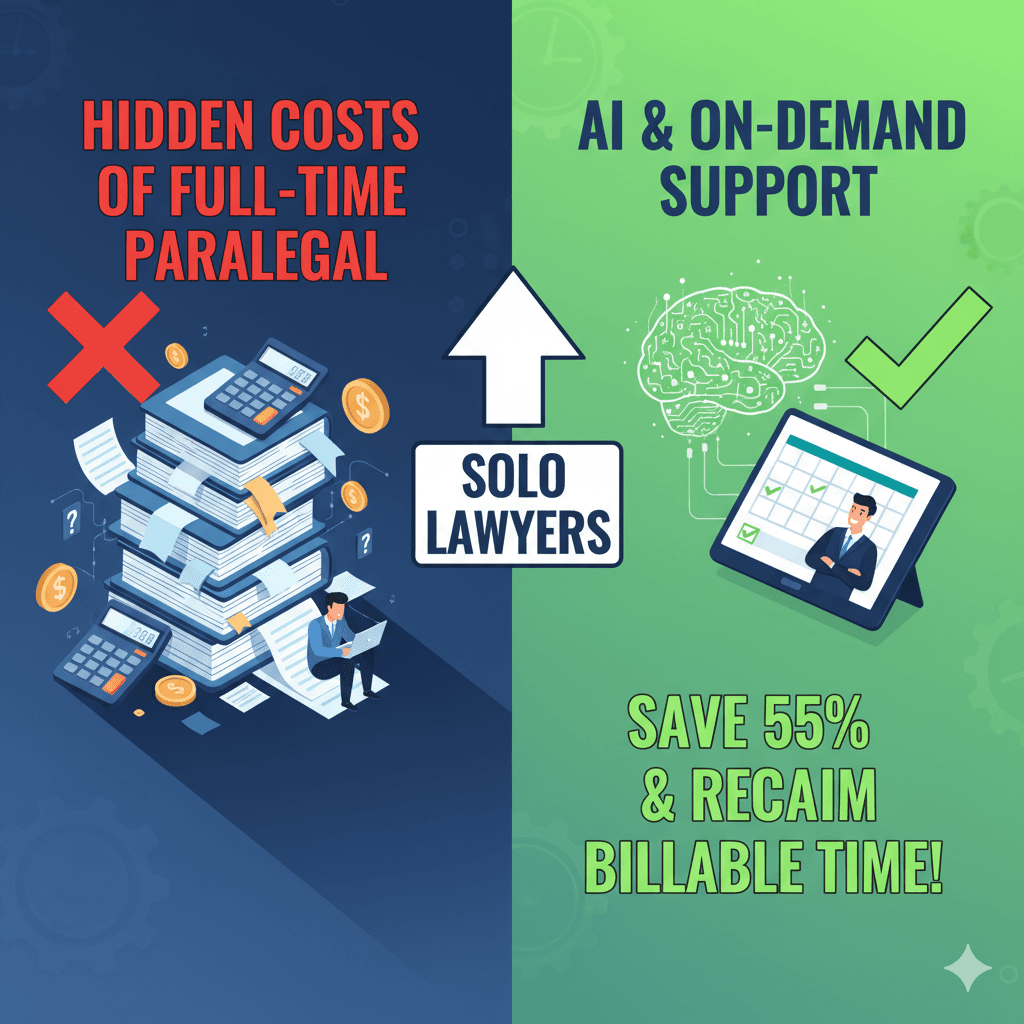
More Than a Salary: The Hidden Math Behind Your Hiring Decision
For many solo lawyers and small legal practices, hiring a full-time paralegal seems straightforward: salary plus benefits equals productivity. But the reality is far more complex. Take Sarah, a family law attorney in Chicago. She hired a paralegal for $65,000 per year. Add rising health insurance premiums, software licenses, and the 10 hours a week she spent managing workflows, and her profits were quietly eroding. Meanwhile, Robert, a personal injury lawyer in Nevada, faced a different problem. His caseload was booming, but the thought of a lengthy, expensive hiring process stopped him from expanding, leaving money on the table every day.
These stories are not unique. According to the 2025 National Association of Legal Professionals (NALP), 72% of small practices underestimate their total personnel expenses by over 25%. Understanding the true cost of a paralegal is the first step toward reclaiming your profitability and your time.
The Iceberg Effect: Hidden Costs of a Full-Time Paralegal
The salary is merely the tip of the iceberg. Beneath the surface lies a substantial mass of indirect expenses that quietly drain profitability. The U.S. Bureau of Labor Statistics (BLS) estimates that the average total compensation cost for a private industry employee is 1.3 times their salary. For a paralegal earning the national median of $62,940, this translates to $81,822 per year.
Direct overheads such as Social Security and Medicare (7.65%), unemployment insurance (1–4%), and rising health insurance costs—averaging $25,000 annually with 78% employer contribution—already push costs far beyond the base salary. Operational expenses for office space, utilities, and technology add another $8,000–$14,000 per year. Recruitment and training are additional hidden drains. The Society for Human Resource Management (SHRM) calculates that hiring a professional costs around $4,700 on average, and onboarding can take three to six months of non-billable senior attorney time.
Even more critical is the opportunity cost. Supervising a paralegal 5–10 hours per week represents lost billable hours. For an attorney billing $350/hour, that's $1,750–$3,500 per week—or over $150,000 annually—spent on management rather than client work. Combine this with reduced utilization from paid time off, administrative tasks, and slow periods, and the financial impact becomes clear: traditional full-time hires are an expensive, fixed-cost liability.
Enter the AI Advantage: Agentic Paralegals
Juris LPO offers a transformative solution. Its Agentic AI paralegals are built to handle routine, time-consuming tasks efficiently and accurately. From drafting court-compliant legal documents to automating formatting, tables, and citations, AI paralegals streamline the workflow. They hyperlink exhibits, proofread for alignment, tone, and style, and provide attorney-ready templates for common tasks. Beyond the mechanics, they explain complex legal topics, such as tax implications, in clear, actionable terms.
What sets Agentic AI paralegals apart is their ability to learn continuously from feedback, improving document compliance and alignment with attorney-specific and court-specific rules. This empowers lawyers to focus on high-value work rather than administrative overhead. Repetitive tasks that once consumed hours are now completed efficiently, accurately, and consistently, allowing attorneys to reclaim billable time and reduce errors.
Affordable Expertise: Human Paralegals on Demand
While AI handles drafting and formatting, Juris LPO also provides U.S.-trained human paralegals for more complex legal work, at a fraction of traditional costs. These professionals take AI-generated drafts and elevate them with detailed research, precise legal citations, motions, pleadings, contracts, and final reviews to ensure accuracy and compliance.
Human paralegals also handle sophisticated formatting, editing, proofreading, and cross-referencing of exhibits and citations, all aligned with court rules and attorney preferences. By combining AI efficiency with human judgment, lawyers gain flexible, scalable support that maintains high standards without the cost of a full-time hire. This hybrid model ensures every document is ready for court submission and every case benefits from strategic, detailed attention.
Real Savings, Real Impact
Consider an Illinois civil litigation attorney who implemented Juris LPO's hybrid model. In the first year, the firm saved over $48,000 in personnel costs while reclaiming 200 billable hours. That's time redirected to client strategy, case development, and business growth—tasks that directly drive revenue.
With flexible AI and human paralegal support, solo practitioners and small practices can scale without risk, reduce overhead, and maintain quality. Whether it's a slow period or a high-volume caseload, resources adjust dynamically to the firm's needs, providing maximum efficiency and cost-effectiveness.
Work Smarter, Not Harder
The legal landscape is evolving rapidly. Fixed-cost, overhead-heavy models are becoming obsolete. For individual lawyers, the future is AI-driven, flexible, and scalable. By leveraging Agentic AI paralegals for drafting, formatting, and repetitive tasks, alongside affordable human paralegals for substantive research and compliance, lawyers can cut costs by over 55%, increase billable hours, and focus on high-impact legal work.
The choice is clear: embrace AI and virtual paralegal support, reclaim your time, and focus on what truly matters—serving clients, winning cases, and growing your practice. In today's fast-moving legal environment, the firms that adapt will not only survive but thrive. The question isn't whether you can afford to change—it's whether you can afford not to.