
In-House Legal Department Outsourcing: A Practical Guide for US Corporate Legal Teams

In-house legal department outsourcing is the practice of sending defined, high-volume legal support work, such as contract administration, legal research, document review and compliance tracking, to an external team of paralegals who work under the supervision of your in-house attorneys. It lets US corporate legal departments add capacity in days instead of months, typically at 40–60% less than the fully loaded cost of a full-time hire, while lawyers keep every judgment call.
Corporate legal teams are being asked to cover more ground with fewer people. According to the 2026 ACC Law Department Management Benchmarking Report, produced with Major, Lindsey & Africa, each in-house lawyer now supports a median of 367 employees, up from about 300 five years ago. Total legal spend has fallen to 0.43% of company revenue, a six-year low.
That gap between workload and headcount is why in-house legal department outsourcing has moved from a stopgap to a standing part of the operating model. This guide covers what it is, what it costs, which tasks fit, how to protect privilege under ABA rules, and how to run a low-risk pilot.
Key points at a glance
- Outsourced paralegals support counsel; they do not give legal advice or appear in court.
- Savings come from paying for output or hours, not salary, benefits, seats and idle time.
- ABA Model Rule 5.3 and Formal Opinion 08-451 allow outsourcing when lawyers supervise and protect confidentiality.
- A single-workload pilot is the safest way to test the model.
What Is In-House Legal Department Outsourcing?
It is a form of legal process outsourcing (LPO) built for corporate legal teams rather than law firms. An external paralegal team takes on procedural, research and documentation work, while your attorneys review and sign off on every deliverable.
The outsourced team works inside your existing tools: your contract lifecycle management (CLM) system, matter management platform, shared drives and Slack or Teams channels. Done well, it feels like an extension of the department, not another vendor to manage.
It is not the same as hiring outside counsel. Outside counsel are licensed attorneys who advise the company. Outsourced paralegal services handle the hours buried beneath that advice, so your lawyers spend their time on risk, negotiation and strategy.
Why US Corporate Legal Departments Are Outsourcing Now
Four pressures are pushing corporate legal department outsourcing into the mainstream in 2026.
1. Headcount is not keeping pace with the business. At 367 employees per lawyer, every in-house attorney carries roughly 22% more of the business than five years ago. Approving a new requisition, recruiting and onboarding a full-time paralegal often takes three to six months, long after the surge has passed.
2. Legal work arrives in spikes. M&A due diligence, regulatory deadlines, litigation discovery and year-end contract renewals do not arrive evenly. Fixed headcount is either overwhelmed or underused. Scalable legal support lets you add a team for six weeks and release it when volume drops.
3. Specialist skills are needed part-time. IP docketing, GDPR and CCPA documentation, and e-discovery platform work each need practised hands, but rarely a full-time role. An outsourced bench gives you that expertise on demand, for example through dedicated IP and trademark support.
4. Counsel time is the scarcest resource. When lawyers stop chasing signature pages and formatting exhibits, they can spend that time advising the business. That is where an in-house team creates the most value.
What this looks like in practice: a two-lawyer legal team at a mid-sized US SaaS company faced a surge in vendor and customer contracts after a product launch. Rather than open a full-time requisition, it engaged an outsourced team for intake, first-pass redlining and clause tracking through its contract support workflow. The backlog cleared in under six weeks, and the engagement scaled down afterward with no severance or idle payroll.
What Does In-House Legal Department Outsourcing Cost?
Outsourced paralegal services typically cost 40–60% less than a fully loaded full-time paralegal, because you pay only for the hours or output you use. In major US markets, a full-time paralegal often costs $75,000 to $95,000 a year once salary, benefits, payroll taxes, software seats and office space are counted.
| Cost factor | Full-time in-house paralegal | Outsourced paralegal team |
| Time to start | 3–6 months (approval, recruiting, onboarding) | 10–15 business days |
| Annual cost | $75,000–$95,000 fully loaded | Typically 40–60% lower for comparable output |
| Benefits, taxes, seat | Paid by the company | Included in the rate |
| Idle time in slow months | Paid | Not paid |
| Specialist skills | Limited to one hire | Drawn from a bench |
| Scaling down | Layoff or reassignment | Adjust scope in the engagement |
The right comparison is cost per completed matter, not hourly rate alone. For a deeper breakdown, see our 2026 paralegal services cost guide, our analysis of full-time paralegal cost savings, and our transparent LPO pricing guide.
Which Tasks Should a Corporate Legal Department Outsource?
Outsource work that is high-volume, rules-based and reviewable by an attorney. Keep anything that requires legal judgment, privileged advice or a court appearance.
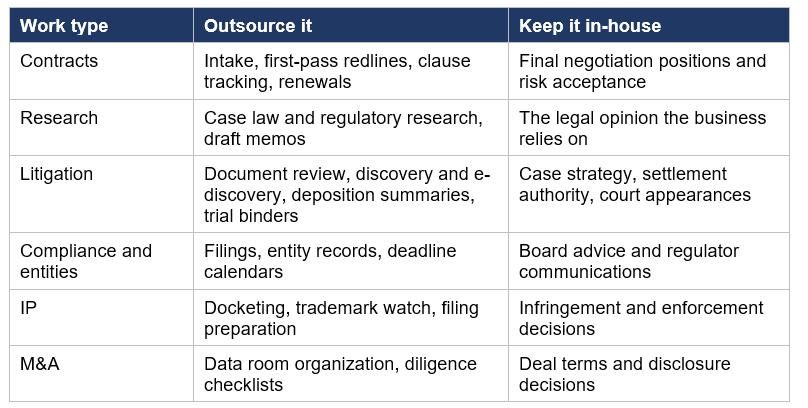
Each of these workloads maps to a dedicated service. Contract work runs through our contract review services, and research memos through legal research and writing. For disputes, we offer litigation support, discovery and e-discovery and deposition summaries. Compliance calendars and entity deadlines sit with our case management and docketing team.
If your department supports specific functions, see how we work in business law, employment law and intellectual property.
Does Outsourcing Put Privilege and Confidentiality at Risk?
Not when it is structured correctly. US ethics rules have permitted legal process outsourcing for years, provided lawyers stay responsible for the work. Most competing guides skip this part, yet it is the first question a general counsel asks.
- ABA Model Rule 5.3 makes supervising lawyers responsible for the conduct of nonlawyer assistants, including those outside the company. Your attorneys must give clear instructions and review the work.
- ABA Formal Opinion 08-451 confirms that lawyers may outsource legal and support work, including offshore, if they supervise competently and protect client information.
- Model Rule 1.6(c) requires reasonable efforts to prevent unauthorized disclosure. In practice, that means NDAs, encrypted transfer and access controls.
- Privilege generally survives when the outsourced team acts as the attorney's agent, under a written confidentiality agreement and at counsel's direction. Confirm the structure in writing and check your state's rules.
Before signing, ask for the provider's data processing agreement and its security framework. Our guide to cybersecurity frameworks in legal outsourcing explains what SOC 2 and ISO 27001 alignment should cover.
This section is general information, not legal advice. Consult your state bar rules for your jurisdiction.
How to Vet an Outsourced Paralegal Partner
Choose a provider that can prove five things before you send a single file.
- Confidentiality infrastructure. Signed NDAs, encrypted file transfer, role-based access and SOC 2 or ISO 27001-aligned data handling.
- A documented review model. Ask how work is checked before it reaches your team. Our approach to quality assurance in LPO deliverables shows what a multi-level review looks like.
- Relevant US practice experience. Look for paralegals trained on US court rules, state filing requirements and your industry's regulations. See our US paralegal services coverage.
- Clear scope boundaries. A one-page engagement charter should list what the team handles and what needs in-house sign-off.
- Onboarding speed and SLAs. Reputable providers onboard in 10–15 business days with written turnaround commitments. Here is how our onboarding process works.
Comparing models? Read virtual paralegal vs. in-house paralegal and how to hire a virtual paralegal.
A 90-Day Pilot Plan for In-House Legal Department Outsourcing
Start with one workload, measure it, then expand. A focused pilot keeps risk low and gives you real numbers to take to the CFO.
- Days 1–30: Scope and set up. Pick one category, such as NDAs or vendor contracts. Record your baseline: volume per month, average turnaround and attorney hours spent. Sign the NDA and DPA, grant tool access and share playbooks.
- Days 31–60: Run and review. The outsourced team handles live work while attorneys review every deliverable. Hold a weekly 30-minute check-in to correct playbook gaps.
- Days 61–90: Measure and decide. Compare turnaround, error rate, attorney hours saved and cost per matter against your baseline. If the numbers hold, add a second workload.
See how it works for the engagement steps, or browse our full list of services.
Budgets are tightening while workloads rise, and the 2026 ACC data confirms what most general counsel already feel. In-house legal department outsourcing closes that capacity gap without long hiring cycles, keeps cost per matter in check, and gives licensed attorneys back the hours they need for judgment calls. Start with a single-workload pilot and let the numbers decide. Ready to scope one? Contact our team.
Frequently Asked Questions
- What is in-house legal department outsourcing?
- It is the practice of assigning defined legal support tasks, such as contract administration, research, document review and compliance tracking, to an external paralegal team that works under your in-house attorneys' supervision.
- Are outsourced paralegal services the same as outside counsel?
- No. Outside counsel are licensed attorneys who give legal advice and represent the company. Outsourced paralegals handle procedural, research and documentation work under the supervision of your in-house or outside attorneys, and do not give legal opinions.
- How much can a corporate legal department save by outsourcing?
- Most departments save about 40–60% compared with a fully loaded full-time paralegal. The savings come from removing benefits, payroll taxes, office space and paid idle time
- Does outsourcing affect attorney-client privilege?
- Privilege is generally preserved when the outsourced team works as the attorney's agent, under a signed confidentiality agreement and direct attorney supervision, consistent with ABA Model Rule 5.3 and Formal Opinion 08-451. Confirm the structure in writing with your provider.
- How quickly can an outsourced paralegal team start?
- Most reputable providers onboard a team in 10–15 business days. That is fast enough for a sudden discovery deadline or M&A due diligence surge.
- Is this model only for large companies?
- No. Small and mid-sized legal departments often benefit most, because they gain the bandwidth of a larger team without adding permanent headcount. Many growing law firms use the same model to scale legal support.