The Compliance Conundrum: Keeping Up With Changing Laws Without Overloading Staff
Overwhelmed and Under Pressure: Why U.S. Law Firms Struggle to Keep Up in 2025
In 2025, over 68% of U.S. law firms reported struggling to keep up with constantly changing regulations, leading to missed deadlines and compliance risks. For small and mid-sized firms, managing tax updates, labor laws, and privacy requirements while keeping staff productive is a growing challenge. Simpson Thacher & Bartlett, a prominent U.S. law firm, was fined £362,000 by England's legal regulator for failing to comply with anti-money laundering regulations in its London office between 2017 and 2023. These real-world examples underscore the hidden costs of overburdened teams and the importance of adopting smarter workflows. In this evolving legal landscape, staying compliant isn't just a matter of avoiding penalties—it's essential for survival and growth.
Streamlining Legal Compliance in 2025: How Hybrid AI and Human Paralegals Keep Law Firms Efficient
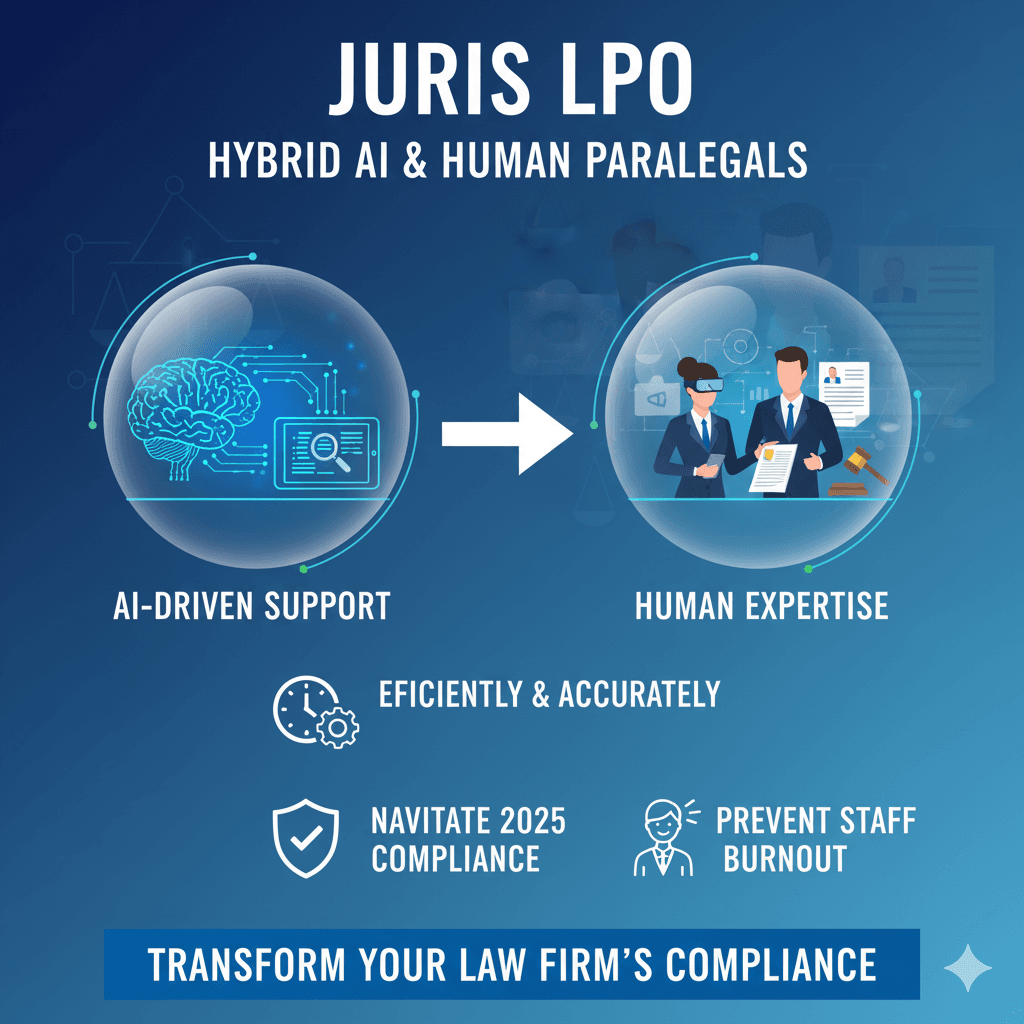
Compliance in today's legal world is not just about staying lawful—it's about protecting your firm and clients while remaining efficient. Many law firms struggle with the volume of updates across federal, state, and local regulations, leaving staff overworked and processes error-prone. Leverage hybrid solutions by Juris LPO, which pair AI-powered paralegals handling routine drafting and formatting with experienced human paralegals managing in-depth research and court-ready documentation. By strategically leveraging these resources, law firms can maintain accuracy, meet deadlines, and reduce burnout, all while staying compliant with the latest regulations.
The Growing Complexity of Compliance in 2025
The regulatory landscape in 2025 is more complex than ever. Federal privacy laws, ESG reporting requirements, labor regulations, and tax changes are evolving rapidly. For instance, state-specific data protection rules now differ widely, requiring firms to tailor compliance processes regionally. According to the Bureau of Economic Analysis, U.S. firms face an average of 15 new compliance requirements annually, adding strain to legal teams. For individual lawyers, staying current is a monumental task; missing a single update can result in fines, reputational damage, or client disputes. High-volume document review, formatting errors, and inconsistent citation practices further amplify risk. Actionable strategies involve identifying repetitive, high-volume tasks and assigning them to AI paralegals, allowing human paralegals to focus on complex research and drafting. For example, a mid-sized law firm in New York successfully implemented a hybrid workflow using AI tools for document formatting while human paralegals focused on drafting motions, cutting turnaround time by 35%. This approach not only reduces errors but also empowers lawyers to focus on higher-value tasks, improving client satisfaction and firm productivity.
From Overload to Efficiency—How Firms Can Adapt
Law firms can transform compliance from a source of stress into a competitive advantage through strategic task allocation. AI paralegals handle repetitive, time-consuming work such as formatting documents, managing citations, and updating templates according to court rules. Meanwhile, human paralegals tackle substantive research, drafting contracts, and preparing pleadings. This hybrid approach ensures that critical tasks receive expert attention without overwhelming staff. A case study from a mid-sized California firm shows that outsourcing compliance research to human paralegals reduced errors in filings by 42%, while AI paralegals maintained formatting consistency across hundreds of documents. Using a simple "Monitor → Draft → Review → Implement" workflow allows firms to stay updated with regulations and implement changes efficiently. Firms adopting this method report improved morale, fewer missed deadlines, and enhanced client confidence. The key lies in understanding which tasks are high-volume and repetitive versus which require nuanced legal expertise—a distinction that Juris LPO handles seamlessly through its AI and human paralegal teams.
Implementation & Next Steps
Implementing an effective compliance strategy starts with mapping out tasks according to complexity. Routine updates such as citation formatting, template updates, and repetitive filings are ideal for AI paralegals, while nuanced research, legal drafting, and court submissions remain with human experts. Firms can integrate workflows into existing systems to streamline operations. For example, a Chicago-based firm successfully assigned AI paralegals to update hundreds of corporate filings across multiple jurisdictions, freeing human paralegals to focus on preparing complex regulatory filings. The forward-looking insight for 2025 is clear: firms adopting hybrid workflows can respond faster to regulatory changes, maintain accuracy, and reduce employee burnout. By combining technology with human expertise, law firms ensure that compliance is managed proactively, rather than reactively, positioning themselves for long-term success. Juris LPO's capabilities—from generating court-compliant drafts to performing comprehensive research—allow multiple attorneys to manage compliance tasks simultaneously without sacrificing quality.
Mastering Compliance in 2025: Smarter Workflows, Less Stress, Zero Errors
Navigating the ever-evolving regulatory landscape of 2025 is one of the biggest challenges facing U.S. law firms today. From frequent updates in federal and state laws to complex filing requirements, staying compliant can easily overwhelm in-house teams. However, by adopting a strategic hybrid approach—leveraging AI paralegals for routine tasks and skilled human paralegals for detailed research and drafting—firms can manage compliance efficiently without overburdening staff. Juris LPO demonstrates that accuracy, efficiency, and scalability are not mutually exclusive. By integrating these solutions, law firms can focus on higher-value legal work, reduce errors, and confidently navigate the compliance conundrum, positioning themselves for sustained growth and client trust in an increasingly complex legal environment.