
Handling High-Volume U.S. Tax Returns: AI + Human Paralegals for Faster Filing
The New Reality of the U.S. Tax Season
As the 2026 tax season begins, U.S. tax professionals are operating in an environment defined by scale, speed, and regulatory complexity. According to IRS processing data, the 2025 financial year involved the handling ofover 270 million tax forms and filings, reflecting the growing volume of individual returns, business filings, schedules, and supporting documentation processed each year.
While electronic filing now dominates professionally prepared submissions, a meaningful portion of filings still require manual handling, review, and compliance checks. For individual lawyers and tax-focused legal practices, this shift means moving beyond advisory work into managing high-volume documentation, formatting accuracy, and regulatory alignment. As filing volumes increase and deadlines tighten, traditional in-house models are struggling to scale efficiently—making U.S. tax return outsourcing a strategic necessity rather than a cost-cutting option.
A Familiar Story for Tax-Focused Legal Practices
Every tax season brings a familiar operational challenge for tax-focused legal practices. What begins in January as a manageable flow of client work often intensifies by March into high volumes of documentation, IRS compliance checks, and formatting-heavy filings. Even experienced attorneys and paralegals find themselves spending significant time on administrative and review-intensive tasks that fall outside core advisory work. As filing volumes grow and deadlines compress, many firms are reassessing how they manage capacity—leading to increased reliance on U.S. tax return outsourcing services to maintain accuracy, meet regulatory standards, and avoid overextending internal teams.
- Burnout from repetitive documentation
- Rework caused by formatting or data errors
- Review bottlenecks delaying filings
- Compliance anxiety and risk of IRS penalties
The Growing Challenge of High-Volume U.S. Tax Returns
High-volume tax return work is no longer limited to large CPA firms. Individual lawyers increasingly support clients with business restructurings, cross-border income, amendments, and compliance-heavy filings. Small professional service firms handle a growing share of pass-through entity filings, significantly increasing documentation complexity.
Key challenges include:
- Repetitive preparation of schedules, exhibits, and reconciliations
- Manual formatting aligned with IRS and court requirements
- Increased audit exposure due to rushed reviews
- Staffing shortages during peak season
- Burnout from repetitive documentation
- Rework caused by formatting or data errors
- Review bottlenecks delaying filings
- Compliance anxiety and risk of IRS penalties
As demand rises, many firms are turning to high-volume tax return outsourcing and tax documentation outsourcing services to stabilize workflows. Scalable support models can significantly improve turnaround times during peak periods. For individual lawyers, outsourcing is no longer about delegation—it is about survival and service continuity.
Benefits of Outsourcing Tax Returns
Outsourcing high-volume tax return processing offers tangible advantages for legal and general tax practices alike:
- Faster Turnaround: Streamline preparation, formatting, and review to meet tight deadlines and seasonal spikes.
- Cost Efficiency: Avoid hiring additional full-time staff during peak periods while maintaining high-quality output.
- Scalable Support: Easily handle large volumes of individual, corporate, or multi-entity filings without overloading internal teams.
- Accuracy and Compliance: Reduce errors, ensure IRS- and court-aligned formatting, and produce audit-ready documentation.
- Consistency and Reliability: Standardized workflows ensure every return follows established protocols, improving client trust and reducing post-filing corrections.
Why AI Alone Is Not Enough—The Case for a Hybrid Model
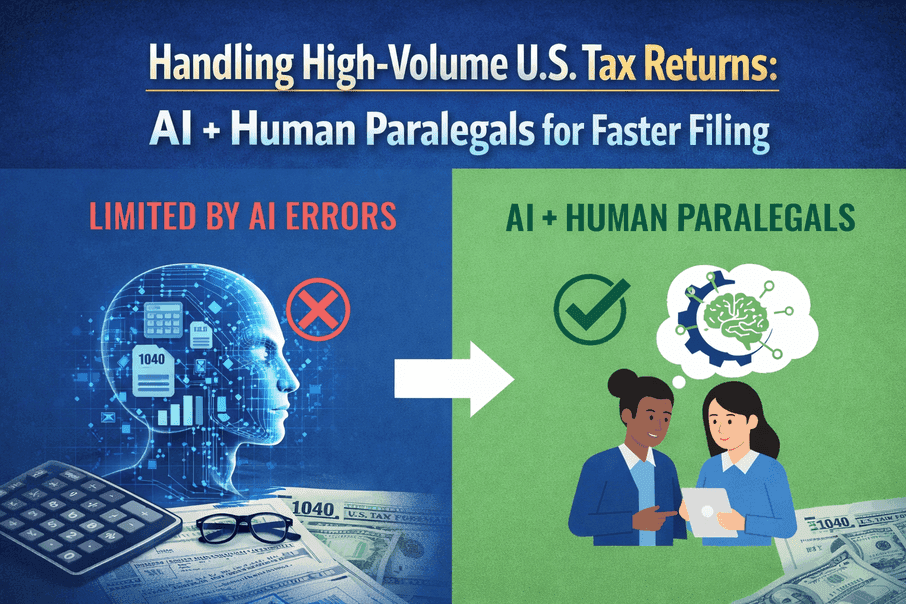
Technology has transformed tax workflows, but AI-assisted tax return processing comes with limitations. While AI excels at speed, structure, and repetitive tasks, regulatory work still demands judgment, context, and accountability. Experience shows that even the most advanced AI systems require human review for a substantial portion of compliance cases.
- AI hallucination risk (misinterpreted data)
- Formatting inconsistency across filings
- Compliance gaps if not human-reviewed
This gap has given rise to hybrid tax processing services, combining AI efficiency with human expertise. In this model:
- AI handles structured draft generation, data organization, and formatting
- Human professionals conduct legal research, apply judgment, and ensure compliance
For lawyers, this approach provides access to AI and human paralegal support that reduces workload without increasing risk. Firms leveraging compliance-focused tax outsourcing experience improved document consistency, fewer errors, and stronger audit preparedness. This balance is especially critical for attorneys managing complex or cross-border matters, where precision is non-negotiable.
Agentic Paralegals vs Generic AI Tools
| Feature | Generic AI | Agentic Paralegals |
|---|---|---|
| Output Type | One-size | Attorney-specific |
| Compliance Learning | None | Feedback-driven |
| Draft Quality | Raw | Court & IRS-aligned |
| Accountability | None | Human-reviewed |
How Juris LPO Enables Scalable, Compliant Tax Processing
Juris LPO’s approach to U.S. tax return outsourcing is built on execution, not abstraction. Our team combinesdeep experience, strict data security, and cost-efficient processes to deliver reliable, audit-ready results for solo lawyers and small legal practices.
Our Agentic Paralegals generate precise, court- and IRS-aligned drafts while strictly adhering to attorney-specific formatting rules. These AI-assisted systems automate repetitive tasks—including tables, citations, exhibits, and hyperlinking—while maintaining a professional, compliant tone.
Every AI-generated draft is then reviewed by Human Paralegals, who handle substantive legal tasks:
- Legal and tax research with proper citations
- Final accuracy and compliance review
- Court-rule and attorney-specific formatting checks
- Accurate legal & tax research
- Final accuracy and IRS compliance
- Attorney-specific and court formatting
- Proofreading and cross-references
This human-reviewed, hybrid model allows individual lawyers to scale confidently during peak season. By leveraging technology-enabled tax outsourcing with a highly skilled, security-conscious team, firms gain speed and efficiency without compromising accuracy, confidentiality, or professional standards—even when managing complex or cross-border filings.
What We Handle vs What Your Team Keeps
We Handle:
- Draft preparation
- Formatting
- Tables & schedules
- Citations
- Hyperlinking
- Proofreading
You Keep:
- Final review
- Client interaction
- Filing authority
Struggling With High-Volume Tax Returns?
- Deadline pressure? Scalable AI + Human Paralegal support
- Compliance risk? Human-reviewed, IRS-aligned workflows
- Operational overload? Offload repetitive documentation
While individual lawyers benefit from scalable outsourcing, Juris LPO also supports a wide range of taxation services across industries. From individual and corporate tax returns to multi-entity filings and compliance-heavy amendments, our hybrid AI + human workflow ensures accuracy, audit-readiness, and timely filing for all high-volume tax scenarios. This includes seasonal filings for accounting firms, small business.
Industries We Serve
- Industries we serve:
- Solo legal practitioners
- Small law firms
- CPA firms handling legal compliance
- Accounting & tax-focused legal teams
In addition to legal teams, Juris LPO serves a broader client base, including small businesses, startups, high-net-worth individuals, and multi-state companies managing complex tax filings. Our flexible outsourcing solutions scale to meet the needs of any high-volume tax scenario, ensuring accuracy, compliance, and timely filing across industries.
High-volume tax filings are complex. They can include:
- Individual and business returns
- Multi-entity filings
- Schedules, exhibits, reconciliations
- Amendments and compliance documentation
A Practical Outsourcing Readiness Toolkit
Before adopting outsourced tax compliance solutions, lawyers should assess readiness using a simple framework:
- Identify tasks suitable for outsourcing, such as draft preparation, formatting, table and exhibit assembly, and review support
- Retain final approval and filing authority internally to ensure compliance and accountability
- Establish clear documentation standards to maintain accuracy, consistency, and audit readiness
This checklist-driven approach helps firms implement secure, scalable tax processing services while preserving control and confidentiality—essential for managing high-volume U.S. tax returns efficiently in 2026.
Pain Points Addressed
- Deadline pressure: Mitigated through scalable, on-demand AI and human paralegal support during peak tax season
- Compliance risk: Reduced via human-reviewed, IRS-aligned workflows that ensure accuracy and regulatory adherence
- Operational overload: Alleviated by offloading repetitive documentation, formatting, and draft preparation
Experience from firms using quality-controlled, compliance-focused tax outsourcing demonstrates improved accuracy, fewer post-filing corrections, and stronger client satisfaction.
Frequently Asked Questions About U.S. Tax Return Outsourcing for Lawyers
- Is U.S. tax return outsourcing fully IRS compliant?
Yes. When implemented with structured workflows and proper safeguards, U.S. tax return outsourcing follows IRS regulations, confidentiality standards, and professional responsibility rules. Using hybrid AI + human paralegal support ensures that all drafts, filings, and documentation are accurate, audit-ready, and compliant with current tax laws.
- Can AI alone safely handle tax return preparation?
AI is excellent for speed, formatting, and structured draft generation. However, human review remains critical for compliance, complex filings, and judgment-based decisions. Hybrid models, like those used by Juris LPO, combine AI efficiency with human oversight to minimize errors, ensure IRS compliance, and reduce post-filing corrections.
- Is tax return outsourcing suitable for solo or small legal practices?
Absolutely. Even individual lawyers or small teams face high-volume documentation and tight deadlines during peak season. Outsourcing allows these practitioners to maintain accuracy, reduce administrative workload, and scale their services without hiring additional full-time staff, all while retaining final filing authority.
- How does outsourcing improve audit readiness and client trust?
By leveraging a structured, quality-controlled workflow, outsourced tax processing ensures that documents are correctly formatted, citations are accurate, and compliance checks are performed consistently. This reduces errors, makes filings audit-ready, and strengthens client confidence in the reliability and professionalism of the legal practice.
Recent Notifications & 2026 Tax Season Updates
As the 2026 tax season begins, the IRS continues to enforce expanded electronic filing requirements for certain business returns and has strengthened audit documentation standards to ensure accuracy and compliance. Additionally, SBA programs encourage professional service firms to adopt technology solutions, making scalable, hybrid tax processing support increasingly accessible for solo practitioners and small legal teams managing high-volume filings.
Final Insights & Take Action
As tax complexity continues to grow, the future belongs to legal professionals who combine expertise with intelligent support systems. U.S. tax return outsourcing is no longer optional—it is the foundation of resilient, compliant practice management.
Ready to streamline your high-volume tax filings? Contact Juris LPO today to explore scalable, human-reviewed, AI-assisted tax return outsourcing solutions tailored for solo lawyers and small legal teams. Ensure accuracy, meet deadlines, and maintain compliance—without expanding permanent staff.
Get in touch now to schedule your consultation and see how we can support your practice this tax season.