
Responding to IRS Notices During Filing Season: Dedicated Paralegal Support for U.S. Firms
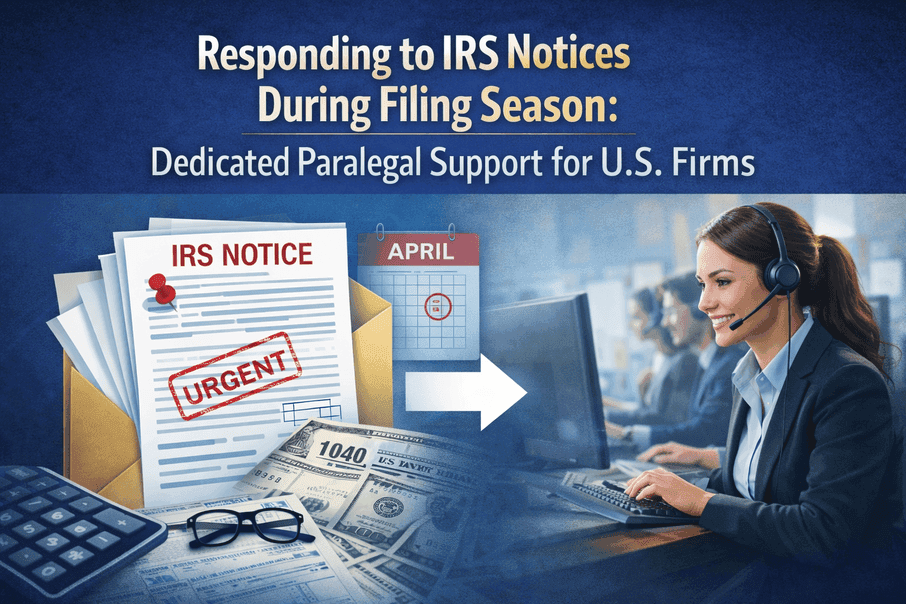
Filing Season Pressure Is at Its Peak
January marks the height of filing season stress for U.S. tax professionals. As return volumes surge, IRS automated systems generate a noticeable increase in filing season IRS notices—including income mismatch letters, balance-due notices, and compliance correspondence. IRS data and industry reporting consistently show that notice activity rises between January and April as returns are processed, data is matched, and discrepancies are identified.
For tax professionals, CPAs, and accounting firms, responding accurately and on time is no longer just a compliance requirement—it has become an operational challenge with real financial and client-service implications.
This is where IRS notice response support becomes critical. Firms without structured IRS correspondence support face missed deadlines, avoidable penalties, and strained client relationships during the most demanding months of the year.
Why IRS Notices Spike During Filing Season—and Where Firms Struggle
Filing season creates a perfect storm for IRS compliance notice response issues. The IRS increasingly relies on automated matching systems that compare W-2s, 1099s, and reported income in near real time. Even minor discrepancies can trigger an IRS tax notice response requirement.
For firms, the challenge isn’t understanding how to respond to IRS notices—it’s managing volume. Industry analyses and practitioner surveys consistently indicate that a majority of IRS notices received during filing season are administrative rather than advisory in nature. These include documentation requests, response drafting, deadline tracking, and correspondence preparation.
Common pain points include:
- Missed IRS notice deadlines due to workload overload.
- Inconsistent formatting and documentation errors.
- Senior professionals spending billable hours on repetitive notice work.
- Lack of scalable IRS notice handling services during peak months.
Without structured IRS notice workload management, firms struggle to maintain response timelines and compliance accuracy.
Common IRS Notices Tax Professionals Handle During Filing Season
During filing season, firms encounter a variety of IRS notices, most of which require timely operational response rather than legal strategy. Understanding the types of notices helps firms prepare workflows and scale efficiently.
Common notices include:
- CP2000 – Income Mismatch Notices: Triggered when the IRS identifies discrepancies between reported income and IRS records.
- CP14 / CP501 – Balance Due Notices: Indicate unpaid taxes or late payments requiring documentation and response.
- CP504 – Collection Follow-ups: Escalated notices for unresolved balances.
- Audit Notices: Inform firms of potential examinations, requiring coordinated documentation preparation.
- Penalty & Interest Notices: Notifications of assessed penalties or accrued interest due to late filings or payments.
- Identity Verification & Compliance Letters (e.g., CP5071C): Requests to verify taxpayer identity or provide additional information.
IRS Notice Response Is an Operational Function—Not Just a Legal One
Many IRS notice resolution workflows become inefficient when firms treat notice response as purely legal or advisory work. In reality, effective IRS correspondence support is driven by execution.
Responding to IRS notices involves:
- Categorizing notices and assigning response timelines.
- Drafting compliant response letters.
- Preparing and formatting supporting documentation.
- Ensuring IRS- and attorney-specific compliance standards.
- Tracking submissions and follow-ups.
This is where IRS notice paralegal support becomes essential. During filing season, outsourced IRS notice response allows firms to scale without compromising compliance.
At Juris LPO, Agentic Paralegals generate precise, compliant drafts aligned with attorney-specific formatting standards. These systems automate repetitive formatting, manage tables, citations, exhibits, hyperlinking, and proofreading—ensuring every document follows strict presentation rules while maintaining a professional, regulator-ready tone.
Human Paralegals then take over for substantive review, handling legal research, citation verification, editing, and final compliance checks. This dual-layer approach enables scalable IRS notice response services without providing legal advice or replacing professional judgment.
Implementing Dedicated Paralegal Support for IRS Notices
For firms facing high-volume IRS notice handling in January and beyond, implementation matters. A dedicated IRS notice support team creates structure during filing season chaos.
Effective IRS notice processing outsourcing includes:
- Centralized intake of IRS correspondence.
- SLA-driven deadline tracking.
- Template-based, IRS-aligned and attorney-reviewed response drafting.
- Secure, NDA-compliant workflows.
- White-label IRS notice support aligned with firm workflows and branding requirements.
This model supports CPAs, accounting firms, tax professionals, and multi-service tax practices—not just law firms. Importantly, IRS notice support without legal advice ensures firms retain full control over strategy while offloading execution-heavy tasks.
By combining Agentic and Human Paralegals, firms gain filing season capacity support without long-term hiring risk, while maintaining consistency, accuracy, and compliance across IRS correspondence.
The Benefits of Outsourcing IRS Notice Response During Filing Season
Outsourcing IRS notice handling provides firms with operational resilience, particularly during peak filing season. By delegating execution-heavy tasks to trained paralegals, firms gain measurable benefits:
- Scalable Capacity: Dedicated teams can rapidly handle high-volume notice surges without hiring additional in-house staff.
- Faster Turnaround: Structured workflows, templates, and SLA-driven processes ensure timely responses.
- Cost Efficiency: Reduces overhead costs compared to seasonal staffing or overtime for internal teams.
- Compliance Accuracy: Experienced paralegals follow IRS and firm-specific formatting, documentation, and tracking standards.
- Reduced Operational Risk: Execution-heavy tasks are managed efficiently, freeing senior staff for advisory and revenue-generating work.
- Zero Long-Term Hiring Commitment: Temporary or seasonal support models allow flexibility without permanent employment costs.
This model lets CPAs, accounting firms, and tax professionals focus on client service while maintaining high-quality, compliant IRS notice responses.
IRS Notice Response Toolkit for Filing Season
To streamline operations during peak filing months, firms benefit from a standardized IRS notice response toolkit:
- IRS notice intake checklist.
- IRS notice response timeline and deadline tracker.
- IRS correspondence drafting templates aligned to common notice types.
- Documentation preparation and review checklist.
These tools reduce errors, improve response speed, and ensure consistent IRS documentation support across teams. A structured toolkit also enables faster onboarding of outsourced IRS notice back-office execution support during filing season peaks—without disrupting existing firm workflows.
Why IRS Notice Handling Breaks Down Without Dedicated Support
During filing season, IRS notice response failures are rarely caused by lack of knowledge—they stem from operational overload.
Common challenges include:
- Deadline Risk: IRS notices carry strict response timelines. Missed deadlines often lead to penalties, escalations, or additional compliance actions that strain firm–client relationships.
- Capacity Constraints: As return volumes surge, in-house teams struggle to absorb rising IRS correspondence. Administrative notice work competes directly with revenue-generating filing tasks.
- Compliance Errors: Inconsistent formatting, incomplete documentation, and rushed submissions increase the likelihood of follow-up notices and prolonged resolution cycles.
Dedicated IRS notice paralegal support addresses these challenges by separating execution from advisory work—ensuring every notice is tracked, drafted, formatted, and submitted accurately while firm leadership stays focused on strategy and client service.
Who Can Benefit From Dedicated IRS Notice Support
IRS notice paralegal support is designed for any tax-focused organization seeking scalable, accurate, and efficient response workflows. This service benefits:
- Tax Attorneys managing notice-heavy caseloads.
- CPA Firms facing high-volume client correspondence.
- Accounting Firms handling routine IRS documentation and follow-ups.
- Tax Resolution Practices managing compliance, penalty, and balance-due notices.
- Multi-Service Tax Practices offering combined advisory, filing, and compliance services.
- High-Volume Seasonal Tax Operations experiencing filing season surges.
By supporting firms across the full taxation spectrum—not just law practices—outsourced IRS notice responses ensure operational continuity, reduces risk, and allows teams to focus on high-value work.
In-House vs. Outsourced IRS Notice Support: A Clear Comparison
Deciding whether to manage IRS notice response in-house or outsource execution-heavy tasks can make a significant operational difference during filing season. The table below illustrates how dedicated outsourced paralegal support outperforms traditional in-house teams on key metrics:
| Task | In-House | Outsourced Paralegal Support |
|---|---|---|
| Response Turnaround | Often slow, bottlenecked by limited staff | Fast and scalable, aligned with SLAs |
| Compliance Risk | Higher risk of formatting errors, missed deadlines, or inconsistent documentation | Lower risk due to trained paralegals and standardized processes |
| Cost per Notice | High, due to overtime, seasonal hires, and senior staff time | Predictable and more cost-efficient without long-term staffing commitments |
Outsourced support allows firms to scale efficiently, maintain compliance, and reduce operational stress, while freeing senior staff to focus on client service and revenue-generating work. This business-centric comparison is a step competitors rarely take, giving your audience clarity and confidence to act.
Real-World IRS Compliance Success
Jones Lang LaSalle (JLL), a global real estate firm, centralized its tax compliance workflows using automation, streamlining documentation and reducing administrative workload across 3,000+ annual returns. This shift from reactive to proactive compliance improved efficiency, accuracy, and internal control—demonstrating how structured operational support can transform filing season performance.
Frequently Asked Questions About IRS Notice Paralegal Support
- Can paralegals respond directly to IRS notices?
Paralegals do not provide legal or tax advice and do not act independently. They prepare IRS-compliant response drafts, supporting documentation, and correspondence packages. Final review, approval, and submission always remain under the firm’s control.
- Is this support suitable for CPAs and accounting firms?
Yes. IRS notice paralegal support is designed for CPAs, accounting firms, tax professionals, and multi-service tax practices. The focus is on execution—document preparation, formatting, tracking, and correspondence management—not advisory or representation services.
- How quickly can support scale during filing season?
Dedicated IRS notice support teams can typically be deployed within days. Workflows are aligned with IRS response deadlines and firm-specific SLAs, allowing rapid scaling during peak filing season without long-term hiring commitments.
Recent IRS Operational Changes Impacting the 2025–2026 Filing Season
During the 2025–2026 filing season, the IRS continues to expand automation as part of its long-term modernization efforts. Increased reliance on automated data matching and correspondence generation has led to a higher volume of IRS notices being issued earlier in the filing cycle.
At the same time, the IRS is placing greater emphasis on timely, well-documented, and properly formatted responses. Standardized correspondence requirements and tighter internal processing workflows mean incomplete or inconsistent submissions are more likely to trigger follow-ups or delays.
For tax professionals, CPAs, and accounting firms, this shift turns IRS notice response into an execution-heavy function—where accuracy, documentation, formatting, and deadline tracking matter as much as technical knowledge. As notice volumes rise and response expectations tighten, structured IRS notice handling services become essential for maintaining compliance and protecting client relationships during peak filing months.
From Filing Season Pressure to Operational Control
The January 2026 filing season does not have to be defined by missed deadlines, overwhelmed teams, or reactive IRS correspondence handling. With a structured, outsourced IRS notice response model, firms can regain operational control while maintaining accuracy, consistency, and compliance under pressure.
Dedicated IRS notice support allows tax professionals, CPAs, and accounting firms to manage rising correspondence volumes without diverting senior resources or compromising turnaround times. By offloading execution-heavy tasks—documentation preparation, compliant response drafting, formatting, and deadline tracking—firms can protect client relationships and scale confidently through peak months.
If your team is facing growing IRS correspondence demands this filing season, now is the right time to implement dedicated IRS notice support built specifically for high-volume, deadline-driven environments.
👉 Talk to a Filing Season Support Specialist