
From Templates to Intelligence: Evolution of Legal Document Drafting Tools
Legal Drafting at the Crossroads: The AI Revolution
The legal profession is standing at a crossroads. In 2024, the U.S. legal-AI market generated approximately US$561.9 million, and the global legal-AI market is estimated at around US$1.4 billion — with projections pointing toward substantial growth in the coming years. This rapid growth signals that artificial intelligence is no longer a marginal experiment, but a component of modern legal practice. For individual lawyers, especially solo practitioners and small firms, this represents a wake-up call. Relying entirely on static templates is increasingly risky. With clients demanding faster turnaround, higher accuracy, and more personalized legal documents, lawyers face an urgent need to adopt AI-powered drafting tools. Traditional methods (manually customizing templates for each case or contract) are becoming inefficient and error-prone. AI promises not just speed but enhanced intelligence: enabling legal professionals to focus on strategy and client outcomes rather than repetitive formatting. This shift is more than theoretical—it’s already reshaping workflows across U.S. law firms, from transactional practices to litigation, enabling attorneys to scale operations without compromising quality.
The Limits of Traditional Templates—and Why Change Is Urgent
For decades, static templates have formed the backbone of legal drafting. They offer structure, predictability, and a baseline of accuracy: standard clauses, formatting, and boilerplate allow lawyers to produce documents efficiently and consistently. But as the legal field accelerates into the AI age, these rigid templates are proving increasingly insufficient. Modern legal work demands more than generic forms; it requires adaptability, context, and the ability to reflect a firm’s unique voice.
In July 2024, the American Bar Association issued Formal Opinion 512, its first comprehensive guidance on the ethical use of generative AI in legal practice. The opinion urges lawyers to verify all AI-generated research, protect client confidentiality, and maintain technological competence when using these tools. Entering 2025, several federal judges—including those in the Northern District of Texas, Eastern District of Pennsylvania, and Northern District of Illinois—expanded or reaffirmed their standing orders on AI disclosure and human verification. While courts acknowledge that AI-assisted drafting is permissible, judges have made clear that attorneys remain fully responsible for confirming the accuracy of every citation, quotation, and legal authority. Recent sanctions in cases involving fabricated citations show that courts are increasingly willing to invoke Rule 11 and refer matters for discipline when unverified AI-generated material appears in filings.
FAQs: AI-Enhanced Legal Proofreading in 2025
1. Do courts allow AI-assisted legal drafting?
Yes — but only with human verification. Since 2023, U.S. courts have reported over 95+ incidents of AI-fabricated citations, leading many judges to require disclosure and attorney verification of any AI-generated material.
2. Can AI replace a paralegal or legal researcher?
No. AI accelerates drafting, but it cannot reliably verify case law, statutes, or court-specific formatting. Human paralegals remain essential for compliance and accuracy.
3. How does AI-enhanced proofreading reduce my risk?
A layered workflow — AI for drafting, humans for verification — prevents hallucinated citations, formatting errors, and Rule 11 violations, strengthening both efficiency and ethical compliance.
Safeguard Your Reputation—Start Your AI-Proofing Workflow Now
2025 is not just a turning point for legal technology — it’s a test of professional integrity. AI-Enhanced Legal Proofreading is no longer optional; it’s essential. By combining Agentic Paralegals to draft court-compliant documents and Human Paralegals to verify, research, and proofread, attorneys can harness the speed of AI without risking ethics or credibility. The Butler Snow case is a stark reminder: if your AI workflow isn’t rigorously supervised, you may be exposing yourself to disqualification, sanctions, or bar discipline.
If you’re ready to upgrade your legal drafting workflow, start by piloting a layered AI+human review system today. Work with a partner like Juris LPO to build your templates, verification checklist, and feedback loop — and protect your practice while accelerating your output.
Recent data underlines this shift. According to AllAboutAI, only 21 percent of law firms in 2025 report firm‑wide use of generative AI, with 39 percent of larger firms (51+ attorneys) on board. The Legal Industry Report from the Federal Bar Association echoes this: roughly 20 percent of smaller firms (50 or fewer lawyers) report implementing legal‑specific AI. While adoption may not yet be universal, it’s growing rapidly — especially for high-volume, repetitive tasks.
Traditional templates remain generic by their nature, and tailoring them to a specific case or client often requires substantial manual work. Lawyers must tediously copy, paste, and adjust clauses to fit factual nuance or court requirements. That process is not only time-consuming but also error-prone: clause misalignment, missing citations, or inconsistent formatting are common risks. And generic templates don’t always capture a firm's stylistic identity or reliably comply with the unique citation and formatting rules imposed by different jurisdictions.
Here’s where AI-enhanced document drafting offers a powerful solution. Modern AI tools can analyze the context of a matter — its facts, legal issues, jurisdictional requirements, and even a firm’s preferred tone — then generate a first draft that is both accurate and aligned with that context. The AI can handle otherwise tedious tasks like table alignment, citation generation, cross-references, and exhibit linking automatically. This frees lawyers to dedicate more time to high-value legal reasoning, strategy, and client counseling.
The efficiency gains are meaningful. According to MyCase’s 2025 guide to AI in law, many attorneys using AI save between 1 and 5 hours per week on tasks like research, drafting correspondence, and document creation. That kind of time saving is especially valuable for solo practitioners or small teams: less time spent on repetitive formatting means more capacity to take on new cases — boosting both productivity and profitability. In short, AI-assisted drafting doesn’t just make things faster; it lets lawyers scale without sacrificing quality.
Implementing AI Drafting in Your Practice
Transitioning from static templates to AI-driven document drafting may feel daunting, but it is increasingly feasible even for individual lawyers. A practical first step is to pilot an AI tool on a specific document type, such as demand letters, motions, or standard contracts. During this pilot, you can deploy a hybrid model: AI generates the first draft, while paralegals perform detailed review, legal research, and compliance checks. In such workflows, human oversight remains essential — lawyers retain responsibility for accuracy, legal arguments, and filing-ready formatting.
Over time, as you gain confidence in the AI’s performance, you can expand its use to other document types across litigation, transactional, or corporate tasks. This gradual adoption helps minimize risk while maximizing efficiency.
The legal AI software market is soaring: according to MarketsandMarkets, it is projected to grow from US$ 3.11 billion in 2025 to US$ 10.82 billion by 2030, driven by generative drafting tools, AI agents, and intelligent document workflows.
By starting small and building a feedback loop — where paralegals and attorneys review AI drafts for style, formatting, and legal reasoning — you can realize meaningful time savings and higher-quality outputs. While AI can handle repetitive tasks, the lawyer’s judgment remains central, and a carefully designed hybrid workflow can help you scale your practice without compromising on legal rigor.
Practical AI Drafting Toolkit for Lawyers
Implementing AI drafting effectively requires a structured, step-by-step approach. Start by identifying the high-volume document types in your practice, such as standard contracts, demand letters, motions, or case intake forms, where AI can deliver the most immediate efficiency gains. Next, select an AI platform that allows customization of templates and, where available, reasoning capabilities to adapt drafts to the specific facts and strategy of each matter.
All AI-generated drafts should then be reviewed by Human Paralegals or attorneys to ensure accuracy, perform detailed legal research, verify citations, maintain compliance with court rules, and check formatting, tables, cross-references, and exhibits. Establishing a continuous feedback loop is critical: reviewing AI outputs and correcting errors over time helps refine the AI’s performance and aligns drafts more closely with firm-specific style and court requirements.
Finally, implement regular compliance checks for court-specific formatting and citation standards to ensure that AI-assisted drafting consistently meets professional and ethical standards. By following this workflow, lawyers can integrate AI into their practice safely and efficiently, improving turnaround times and allowing more focus on strategic legal work.
FAQs
- Is AI drafting ethically safe for lawyers?
AI is a safe tool when used responsibly. Lawyers must review and approve all AI-generated drafts, as professional responsibility rules hold them accountable for content filed with courts.
- Will AI replace paralegals or junior associates?
AI reduces repetitive drafting work but does not replace legal professionals. Human oversight remains essential for research, analysis, and compliance.
- How much does it cost to implement AI drafting tools?
Costs vary by firm size and platform. For instance, Eve’s pricing depends on usage, but early adopters consistently report ROI through time savings and increased capacity.
Navigating 2025: AI, ALSP Growth, and Lawyer Responsibilities
The U.S. ALSP market reached an estimated US$ 28.5 billion as of 2023, according to a January 2025 report by Thomson Reuters, reflecting an approximate 18% compound annual growth rate from 2021 to 2023. Generative AI is increasingly cited as a catalyst for this growth as ALSPs enhance tech‑driven service delivery. At the same time, regulatory and professional guidance is evolving: the American Bar Association’s 2024 ethics opinion cautions lawyers that, even when using AI tools, they must maintain control, verify outputs, protect client confidentiality, and remain ultimately responsible for documents filed in court.
From Templates to Intelligence: The New Era for Lawyers
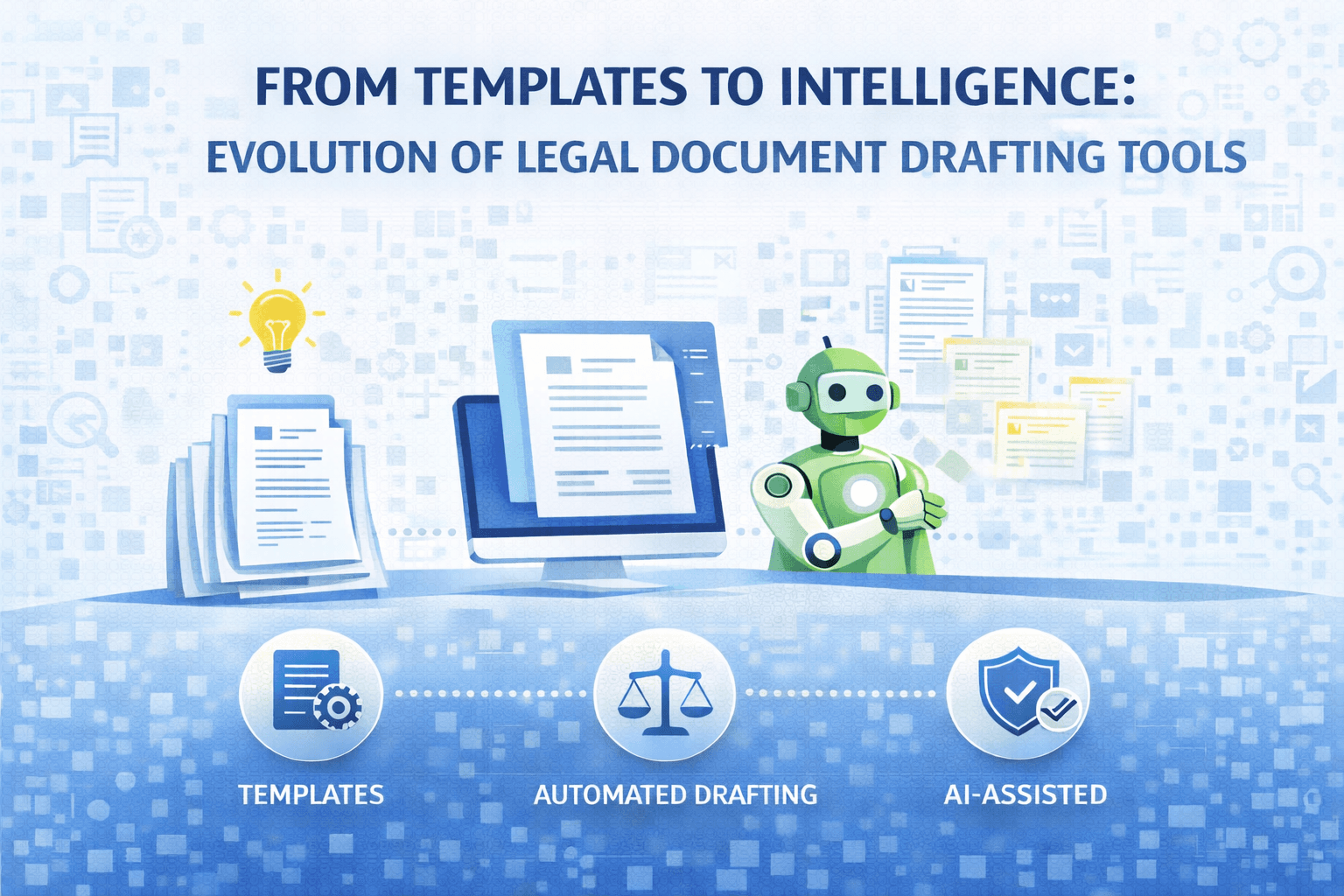
The evolution from static templates to AI-enhanced legal drafting is not a futuristic concept; it is the present reality for forward-looking law firms. Individual lawyers adopting AI can achieve faster document creation, better legal analysis, and increased capacity to handle complex matters. By leveraging AI alongside skilled paralegals, practices can maintain rigorous standards while embracing efficiencies that redefine how legal work is performed. The next step in this series will explore AI’s impact on litigation support, from discovery to motion strategy, demonstrating even greater opportunities for lawyers to enhance their practice with technology.
Upgrade Your Legal Drafting with AI and Expert Paralegals
Move beyond static templates. With Juris LPO, Agentic Paralegals generate court-compliant drafts while Human Paralegals refine, research, and ensure accuracy. Save time, reduce errors, and focus on strategy.