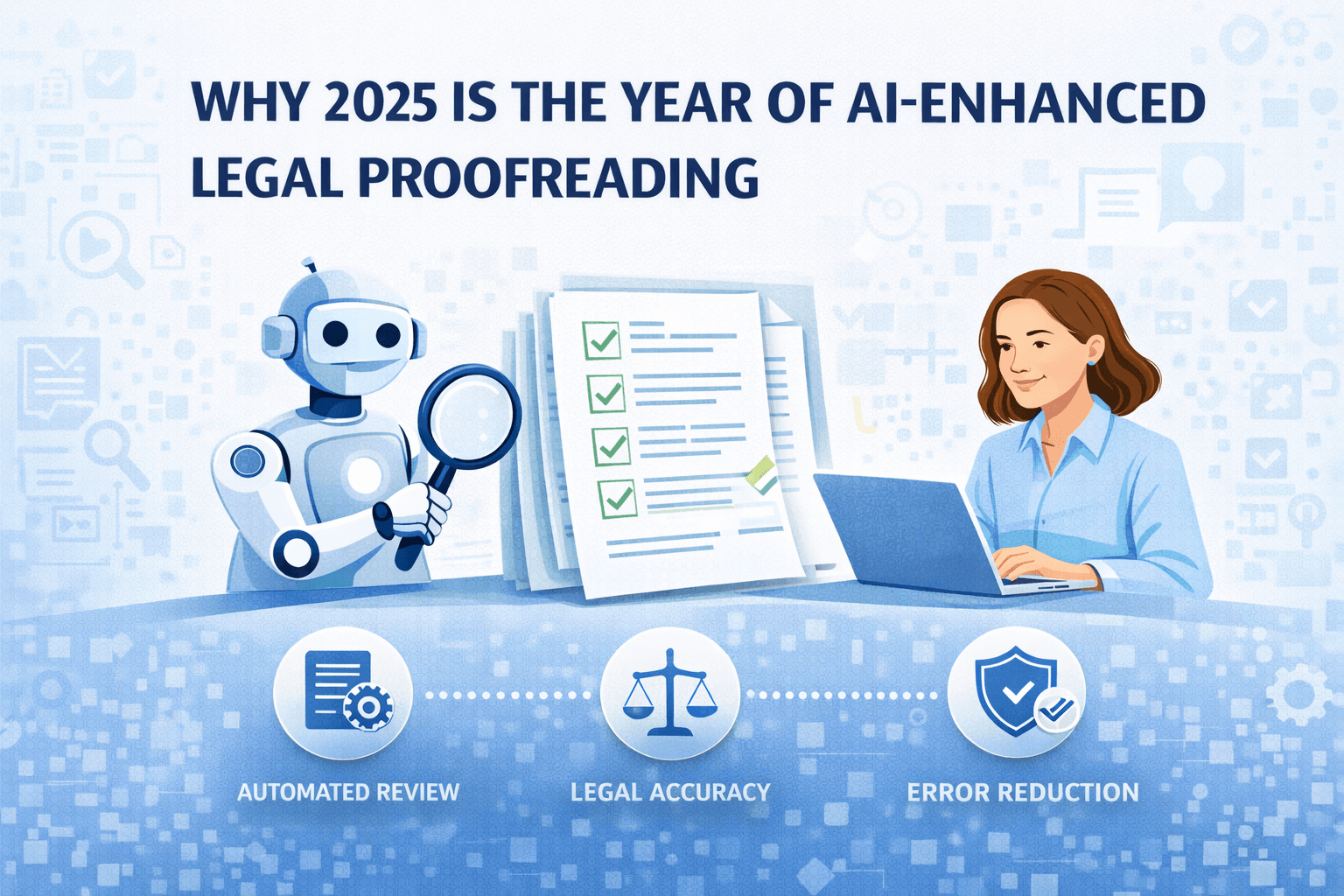
Why 2025 Is the Year of AI-Enhanced Legal Proofreading
A Legal Shockwave in 2025
By early 2025, U.S. courts had issued a clear warning to the profession: generative AI may speed up drafting, but it cannot be trusted without human verification. Multiple federal judges reported receiving filings containing fake citations produced by unverified AI tools, and high-profile sanction orders have brought the issue into national focus. While most incidents involved pro se litigants, the Butler Snow case demonstrated that even large firms are vulnerable when AI output goes unchecked. For solo and small-firm lawyers, the message is unmistakable — in an era of rising AI adoption, AI-enhanced legal proofreading is now an ethical necessity, not a competitive advantage. Attorneys who fail to verify AI-assisted research risk sanctions, reputational damage, and violations of Rule 11 duties.
The Double-Edged Rise of AI in Legal Drafting
The adoption of generative AI in legal work is surging, but so are the dangers. Major media outlets report that courts across the U.S. are now flooded with filings containing "nonexistent research hallucinated by generative artificial intelligence." Legal researchers have documented at least 95 incidents since mid-2023, and these errors aren’t limited to pro se litigants — large law firms are affected too. For a lawyer struggling with tight deadlines or heavy caseloads, it’s tempting to lean on AI for drafting. AI can indeed accelerate first drafts of motions, summonses, pleadings, and even memos. But when that speed comes with the risk of entirely fabricated case law, the stakes are professional — and court-level.
This is where AI-enhanced legal proofreading becomes indispensable. Rather than replacing human review, it needs to augment it. By establishing a workflow where AI generates a first draft and then human professionals inspect and verify, lawyers can reclaim both efficiency and reliability. The most successful practitioners in 2025 won’t be those who avoid AI — they’ll be those who manage it responsibly.
Case Study: The Butler Snow Scandal That Redefined Risk
In May–July 2025, one of the most widely reported AI-related legal ethics incidents involved three attorneys from Butler Snow LLP who were sanctioned after submitting court filings that contained fabricated legal citations generated by ChatGPT. According to the Associated Press, Reuters, The Guardian, and court documents, U.S. District Judge Anna Manasco found that the attorneys—Matthew B. Reeves, William J. Cranford, and William R. Lunsford—included case citations in a federal filing defending the Alabama Department of Corrections that were “completely made up” and had never appeared in any federal or state reporter.
Judge Anna Manasco found that one of the Butler Snow attorneys had used ChatGPT to generate case citations and then failed to independently verify those citations through trusted legal research tools such as Westlaw or PACER, as he admitted in his own filing. In her order, Judge Manasco wrote that “fabricating legal authority is serious misconduct” and concluded that the attorneys’ failure to conduct even basic verification amounted to “recklessness in the extreme,” not a simple oversight. Her ruling emphasized that submitting nonexistent cases to a federal court fundamentally undermines the integrity of the judicial process.
As a result, Judge Manasco:
- Disqualified all three attorneys from continuing in the case,
- Referred the matter to the Alabama State Bar for potential discipline, and
- Ordered that the sanction be shared with their clients, opposing counsel, and other courts where similar filings were made.
Butler Snow responded by hiring the national law firm Morgan, Lewis & Bockius to conduct an internal audit of approximately 40 other cases involving the three sanctioned attorneys to determine whether any similar AI-generated errors had occurred. The firm also confirmed in media statements that the attorneys’ actions violated its internal guidance on generative AI use and reiterated its policy requiring attorneys to independently verify any AI-assisted research.
This case became a national wake-up call for the U.S. legal sector. The Guardian noted that it was among the clearest examples of how generative AI—when used without adequate supervision—can directly threaten professional accountability, client trust, and compliance with Rule 11 obligations. Within weeks, U.S. firms across several states began issuing formal AI-use policies requiring manual verification of all AI-assisted citations, filings, or drafted language before submission.
How AI-Enhanced Proofreading Works
AI-enhanced proofreading operates through a two-layer workflow designed to ensure both efficiency and legal reliability. In the first layer, Agentic Paralegals produce structured, court-compliant draft documents. These drafts go far beyond generic AI output: they follow court formatting requirements, apply preferred writing styles, and include components such as exhibits, tables, cross-references, and hyperlinks. This significantly reduces repetitive administrative work and gives attorneys a well-organized, professional starting point.
In the second layer, Human Paralegals step in to perform the essential verification work that AI cannot reliably do on its own. They conduct thorough legal research, confirm the accuracy and existence of all citations using authoritative databases, ensure correct Bluebook or jurisdiction-specific citation formatting, and review the document for factual and stylistic consistency. They also validate cross-references, check hyperlinks, assess the strength of arguments, and identify any potential AI hallucinations. This human review transforms the AI-generated draft into a fully compliant, court-ready document.
Without this structured two-step process, AI-generated materials remain vulnerable to errors and ethical risks. But when paired with rigorous human verification, AI becomes a powerful tool that enhances efficiency, strengthens compliance, and supports higher-quality legal work.
Real-World Challenges and Ethical Responsibility
Working this way isn’t without challenges. Some attorneys resist adding more steps to their process because they feel AI alone should be enough. But recent court decisions have made clear that relying solely on AI can violate ethical and procedural rules. In one instance, a retired magistrate judge admitted he was “initially persuaded” by AI-generated citations that later turned out to be fake. In another case, a judge imposed $31,000 in sanctions under Rule 11 for the submission of a brief with persistent AI-hallucinated authorities.
The message from courts is consistent: AI is acceptable, but so is accountability. Lawyers cannot delegate their professional responsibility to a machine. Ethical obligations — competence, diligence, candor — still belong to the human lawyer. Human review is not just a nice-to-have; it is the legal profession’s frontline defense against malpractice.
Building an AI-Safe Toolkit for Your Practice
To safely integrate AI-enhanced proofreading into your legal workflow, the most effective approach is to build a structured, repeatable toolkit. Start by creating a template library aligned with local and federal court rules, including standardized margins, fonts, headings, caption formats, and exhibit layouts. Agentic Paralegals can use these templates to ensure all first drafts adhere to jurisdictional requirements from the outset.
Next, develop a verification checklist for Human Paralegals to follow during their review. This checklist should include steps for:
Next, establish a verification checklist for Human Paralegals. This checklist should require confirmation of every case’s existence, validation of quotations and pinpoint cites, review of statutory references, verification of all cross-references and exhibits, and a final proofreading pass for tone and style. This step ensures legal accuracy and ethical compliance.
Finally, maintain a feedback log capturing any AI hallucinations or inconsistencies identified during human review. Each entry helps refine prompts, templates, and workflows, resulting in progressively more accurate drafts. Over time, this creates a self-correcting system where AI output becomes more reliable, workload decreases, and your team consistently produces court-ready, defensible documents.
The 2025 Rulebook: What Courts Now Expect From AI-Assisted Filings
In July 2024, the American Bar Association issued Formal Opinion 512, its first comprehensive guidance on the ethical use of generative AI in legal practice. The opinion urges lawyers to verify all AI-generated research, protect client confidentiality, and maintain technological competence when using these tools. Entering 2025, several federal judges—including those in the Northern District of Texas, Eastern District of Pennsylvania, and Northern District of Illinois—expanded or reaffirmed their standing orders on AI disclosure and human verification. While courts acknowledge that AI-assisted drafting is permissible, judges have made clear that attorneys remain fully responsible for confirming the accuracy of every citation, quotation, and legal authority. Recent sanctions in cases involving fabricated citations show that courts are increasingly willing to invoke Rule 11 and refer matters for discipline when unverified AI-generated material appears in filings.
FAQs: AI-Enhanced Legal Proofreading in 2025
1. Do courts allow AI-assisted legal drafting?
Yes — but only with human verification. Since 2023, U.S. courts have reported over 95+ incidents of AI-fabricated citations, leading many judges to require disclosure and attorney verification of any AI-generated material.
2. Can AI replace a paralegal or legal researcher?
No. AI accelerates drafting, but it cannot reliably verify case law, statutes, or court-specific formatting. Human paralegals remain essential for compliance and accuracy.
3. How does AI-enhanced proofreading reduce my risk?
A layered workflow — AI for drafting, humans for verification — prevents hallucinated citations, formatting errors, and Rule 11 violations, strengthening both efficiency and ethical compliance.
Safeguard Your Reputation—Start Your AI-Proofing Workflow Now
2025 is not just a turning point for legal technology — it’s a test of professional integrity. AI-Enhanced Legal Proofreading is no longer optional; it’s essential. By combining Agentic Paralegals to draft court-compliant documents and Human Paralegals to verify, research, and proofread, attorneys can harness the speed of AI without risking ethics or credibility. The Butler Snow case is a stark reminder: if your AI workflow isn’t rigorously supervised, you may be exposing yourself to disqualification, sanctions, or bar discipline.
If you’re ready to upgrade your legal drafting workflow, start by piloting a layered AI+human review system today. Work with a partner like Juris LPO to build your templates, verification checklist, and feedback loop — and protect your practice while accelerating your output.