
Legal Document QA Metrics: Measuring AI Drafting Accuracy in 2026
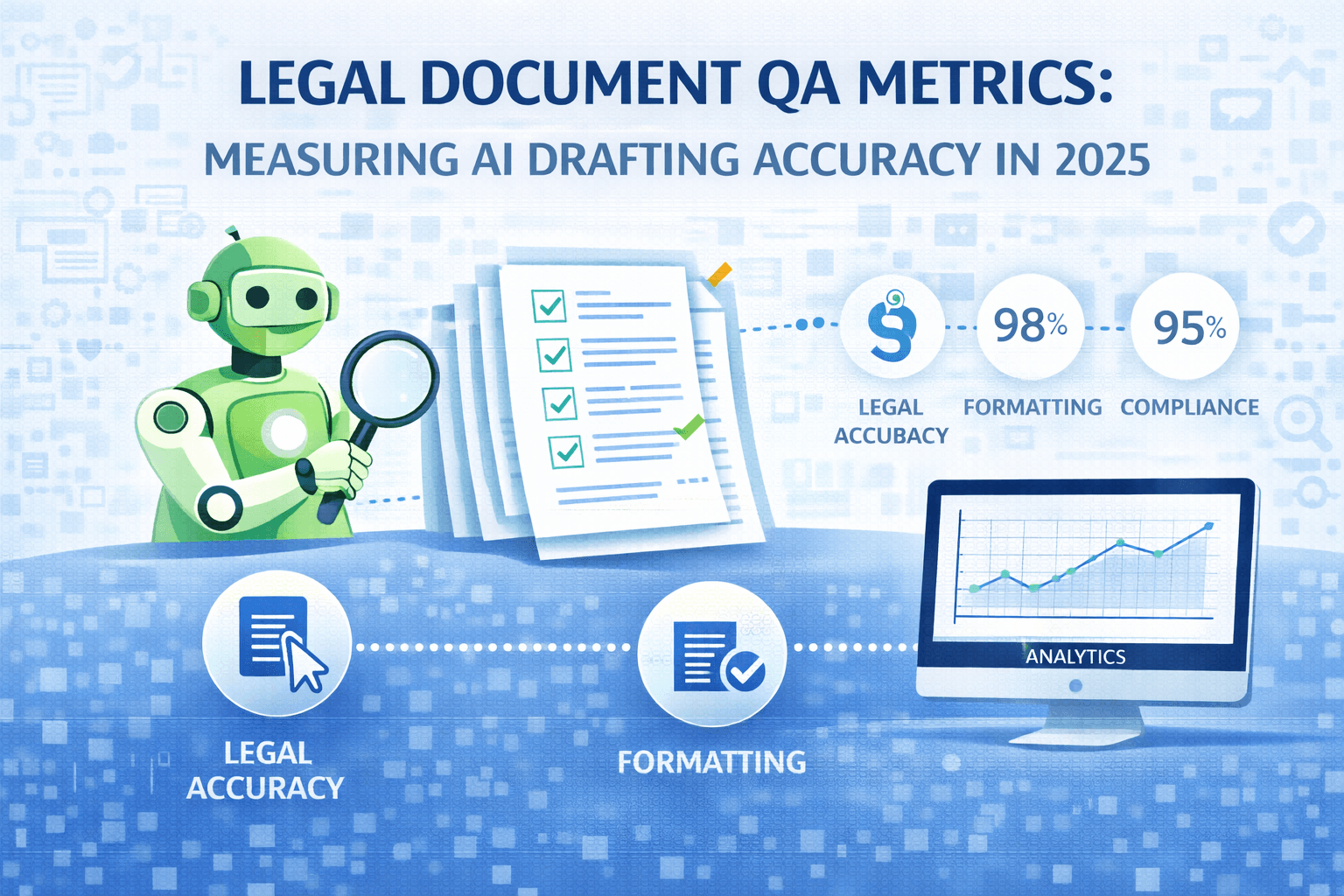
Why 2025 Became the Year of AI Drafting Accountability
By 2025, AI-assisted drafting has shifted from curiosity to a cautious but growing part of legal practice. While only about 13% of U.S. lawyers use generative AI tools daily, a much larger share is actively experimenting with them as pressure builds to increase efficiency. Yet this gradual adoption has exposed a wave of accuracy concerns—misquoted statutes, outdated case citations, hallucinated authorities, clause drift, and formatting errors that have led to rejected filings and judicial warnings. As courts introduce AI-use disclosure rules and malpractice insurers begin evaluating firms’ AI-governance practices, attorneys are realizing a critical truth: speed is irrelevant without precision. In 2025, measurable legal document QA metrics have become essential for producing safe, compliant, and defensible AI-powered drafts.
AI’s New Benchmarks — Why QA Metrics Became Mandatory in U.S. Legal Drafting
The rise of generative AI in the legal sector has forced the profession to modernize its risk controls. Recent ABA technology surveys show a steady increase in AI experimentation among U.S. attorneys, particularly within larger firms, but adoption still varies widely across the industry. As AI tools began influencing research, drafting, and document review, accuracy standards shifted from optional to essential. Today, many firms monitor clause consistency, citation reliability, formatting compliance, and error-flagging accuracy whenever AI is involved.
The most influential wake-up call came from the widely publicized Mata v. Avianca (2023) incident, where fabricated AI-generated case citations resulted in court sanctions. This case didn’t just expose the risks of unverified AI outputs — it triggered nationwide debates on attorney diligence and technological competence. By 2025, firms were not necessarily facing new types of sanctions, but they were increasingly updating internal policies, checklists, and verification protocols to avoid similar outcomes. The trend is clear: verification of AI-assisted work is now treated as a core professional duty, not a discretionary step.
Pressure is also mounting from outside the courtroom. Clients expect faster turnaround times, courts expect procedural compliance, and legal malpractice insurers increasingly evaluate a firm’s AI governance practices before underwriting risk. For attorneys drafting contracts, motions, discovery responses, and compliance documents, implementing structured QA metrics has become the most reliable way to balance speed, defensibility, and ethical obligations in the era of AI-enabled legal work.
Clause-Level Precision — The New Gold Standard of AI Legal Drafting Accuracy
Clause-level precision is increasingly recognized as a critical consideration in AI-assisted legal drafting. Rather than focusing only on grammar or general formatting, QA approaches evaluate whether each clause aligns with statutory language, jurisdiction-specific requirements, and an attorney’s preferred drafting standards. Legal technology analyses indicate that most AI-generated drafting errors occur in micro-details rather than in the overall document structure—such as misplaced definitions, inaccurate venue references, inconsistent cross-references, or subtle clause drift that can change the intended meaning.
Firms and practitioners are exploring granular review protocols to manage these risks, often combining AI-assisted checks with human oversight. While there is no universally adopted framework, many legal teams report that structured verification and careful review help reduce errors and improve draft reliability.
For individual lawyers, clause-level QA is especially useful for detecting errors that are easy to overlook, including inaccurate citations, outdated statutory language, missing signature blocks, or captions that fail to meet jurisdiction-specific formatting requirements. By validating internal coherence and ensuring alignment with statutory rules, clause-level QA complements traditional legal review, helping attorneys maintain accuracy, consistency, and defensibility in AI-assisted documents.
As courts continue to emphasize precision and compliance, these metrics provide a safeguard that allows attorneys to leverage AI efficiently while maintaining professional responsibility and risk management.
Beyond Accuracy — Measuring Compliance, Formatting, and Risk Signals in AI Drafting
By 2025, accuracy alone is no longer enough for AI-assisted legal drafting. U.S. courts continue to enforce formatting and procedural requirements with strict consistency, and filings can be rejected for issues as simple as incorrect captions, font sizes, margin spacing, or missing certificates of service. While courts do not publicly attribute errors to AI, legal-tech analyses and attorney accounts confirm that formatting and compliance mistakes remain among the most common reasons for rejected or corrected submissions.
This shift has pushed modern AI QA systems to examine far more than grammar or structure. The leading tools now evaluate Bluebook citation integrity, jurisdiction-specific rules, cross-reference consistency, and even drafting tone. Many also incorporate readability scores and clause-level risk signals to help lawyers identify ambiguous, conflicting, or noncompliant provisions before they reach the court.
A widely discussed theme across 2024–2025 legal-tech conferences involves attorneys discovering that AI-generated drafts often miss critical procedural elements—such as updated rule references or required service statements. These are preventable errors when supported by robust QA metrics that validate every component of a filing against court expectations.
Juris LPO’s agentic paralegal workflow strengthens this safeguard by pairing automated QA with human legal review. AI ensures clause alignment, formatting consistency, and risk flagging, while human paralegals perform legal research, update citations, refine arguments, and incorporate attorney-specific preferences. Together, they deliver documents that are court-ready, compliant, and defensible—balancing speed with the precision the legal system demands.
Implementing AI QA Metrics — A Practical Roadmap for Attorneys
Attorneys adopting AI drafting tools often face the same challenge: integrating speed with reliability. The firms that succeed typically follow a three-part workflow—defining quality benchmarks, implementing automated scoring tools, and maintaining a human review layer. The biggest barrier remains the “trust gap.” Lawyers value AI efficiency but worry about hidden inaccuracies or subtle clause drift. QA metrics close this gap by offering transparent scoring across accuracy, compliance, tone, structural consistency, and citation integrity.
Many modern drafting tools now integrate directly with practice management and document management systems, allowing automated checks against firm templates, jurisdictional rulesets, and attorney style guides. But human review is still indispensable. Juris LPO’s hybrid model pairs AI-generated drafts with trained paralegals who proofread, update Bluebook citations, format exhibits, and ensure strict compliance with local and federal court rules.
Looking ahead, several courts have already introduced standing orders requiring disclosure when AI is used in filings, and legal scholars anticipate broader governance expectations as AI becomes more embedded in practice. This makes adopting standardized QA metrics today not only a safeguard, but a forward-looking strategy for attorneys preparing for an increasingly regulated AI landscape.
Attorney’s Toolkit — The QA Metrics Checklist for 2025
AI-assisted drafting continues to evolve, and attorneys increasingly use quality assurance approaches to reduce errors and maintain compliance. While there is no single standardized framework dominating practice in 2025, common QA practices focus on validating clause accuracy, ensuring proper formatting, checking citations and statutory references, and detecting potential ambiguities or inconsistencies. Firms often pair automated QA tools with human review to safeguard compliance and improve efficiency. These approaches help attorneys manage risk, maintain defensible documentation, and integrate AI tools into their workflows without over-relying on automated outputs.
FAQs
How accurate is AI in legal drafting in 2025?
AI can achieve 92–96% clause-level accuracy when paired with human QA processes.
Do courts accept AI-generated documents?
Yes, but courts require compliance with formatting and citation rules, and filings may be rejected if AI introduces errors.
Is human review still necessary?
Absolutely. AI accelerates drafting, but human review ensures legal reasoning, compliance, and jurisdiction-specific accuracy.
2025 Regulatory Shifts Reshaping Legal Document QA
As of early 2025, regulatory and procedural changes are reshaping how law firms approach AI-assisted drafting. Federal and state courts are updating local rules on formatting, e-filing, and document metadata, requiring closer attention to structure, citations, and procedural compliance. States including California, Texas, New York, and Illinois have introduced guidelines affecting e-filing standards and indirectly influencing AI document workflows. At the same time, malpractice insurers are scrutinizing AI governance practices, asking firms about oversight, audit trails, and QA procedures before approving coverage. These trends reinforce that robust QA and accountability measures are essential for attorneys using AI, helping firms mitigate risk, ensure compliance, and maintain defensible, court-ready documents.
Mastering AI Legal Drafting — The Path Forward
As AI becomes an integral part of legal practice in 2025, attorneys can no longer rely on speed alone; precision, compliance, and risk mitigation are equally critical. Implementing structured QA metrics—covering clause accuracy, formatting, citations, and procedural compliance—ensures that AI-assisted drafts meet the highest professional and court standards. Firms that integrate automated scoring with human review not only reduce errors and revisions but also strengthen defensibility and client trust. To stay ahead in this evolving landscape, attorneys should adopt standardized QA frameworks today, continuously refine workflows, and leverage hybrid AI-human systems that safeguard both efficiency and accuracy.
Begin evaluating your firm’s AI drafting processes now. Implement clause-level QA metrics, integrate automated validation tools, and train your team on hybrid review workflows to ensure every document is court-ready, compliant, and defensible.