
Alternative Business Structures (ABS) and the Rise of AI-Augmented Law Firms
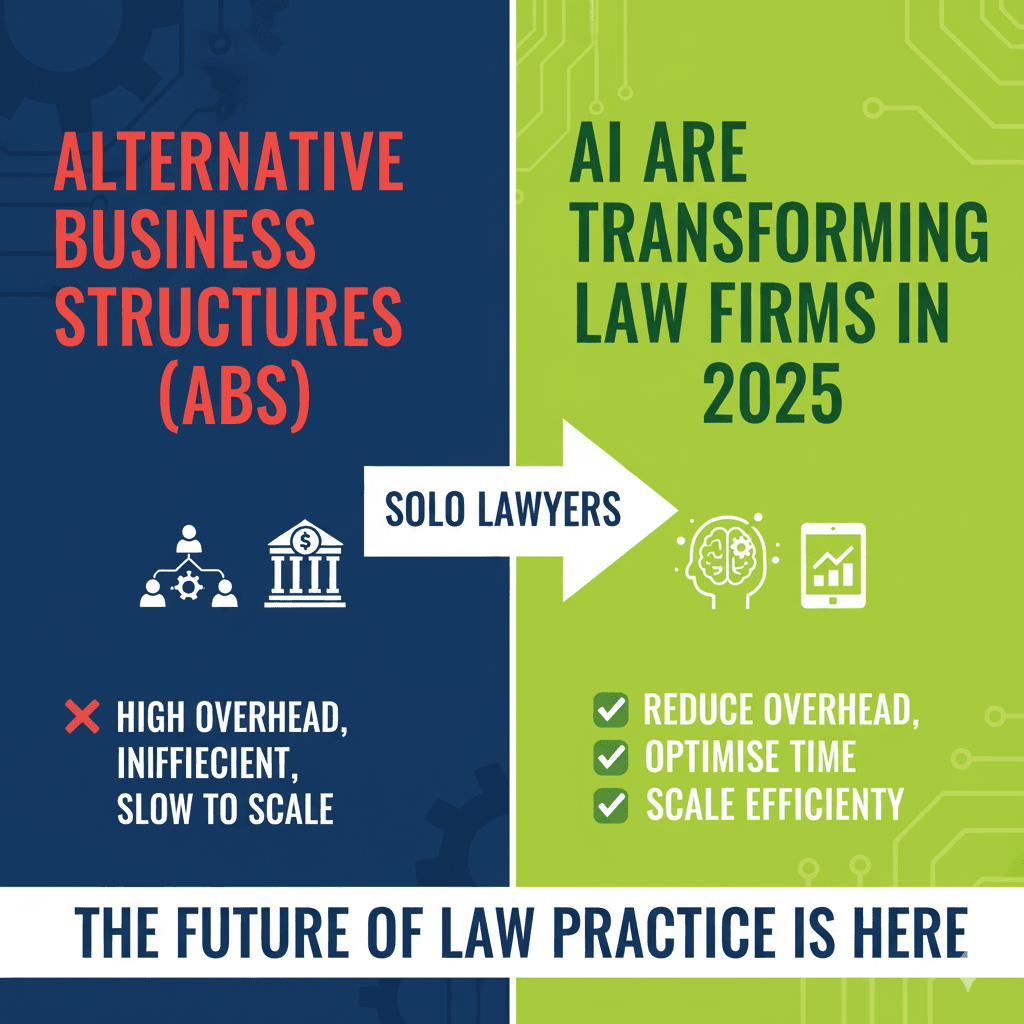
The Legal Revolution: How ABS and AI Are Reshaping Law Firms in 2025
In 2025, law firms that do not adapt to new ownership models or embrace technology risk being left behind. Arizona alone has approved over 100 Alternative Business Structures (ABS) since introducing nonlawyer ownership rules, including KPMG Law US, the first Big Four firm to apply under this framework. Simultaneously, more than fifty-three percent of small and solo law firms have integrated generative AI into workflows, nearly doubling adoption since 2023. For lawyers, these trends create urgency: clients increasingly seek faster, more efficient, and technologically sophisticated legal services, and firms that fail to evolve will struggle to remain competitive.
Introduction: From Tradition to Transformation
Imagine a boutique litigation lawyer in Phoenix partnering with a technology entrepreneur. Under traditional regulations, such a collaboration would have been impossible, but ABS allows this structure legally. With capital infusion and tech expertise, the firm offers subscription-based legal services, automated contract review, and predictive case insights powered by AI. This convergence of ABS and AI is no longer hypothetical; it is becoming a practical reality that individual lawyers must understand and embrace to remain competitive in 2025.
Why ABS Matters — A New Business Frontier
Alternative Business Structures represent a fundamental shift in how law firms can operate. Historically, ABA Model Rule 5.4 prohibited nonlawyers from owning or controlling law firms. This limitation restricted access to external capital, slowed innovation, and constrained integration with services such as technology, marketing, or analytics. ABS models, which permit outside investment or nonlawyer participation under regulated frameworks, are now emerging as a solution. As of 2025, jurisdictions such as Arizona, Utah, and the District of Columbia permit some form of ABS, while other states, including California, are actively debating reforms like Assembly Bill 931, which would restrict cross-state ABS collaborations. The benefits for individual lawyers are clear. ABS provides access to capital, enabling growth and innovation, and facilitates integration with other professional services to offer more comprehensive client solutions. Firms leveraging ABS can implement subscription models, technology-driven services, and predictive analytics that traditional law firm structures cannot efficiently support. For lawyers in states without ABS, it is essential to monitor competitors in ABS jurisdictions and begin developing the technological and operational readiness necessary to adopt ABS when regulatory conditions permit.
AI and ABS — The Hybrid Edge
The strategic advantage of ABS is maximized when combined with AI-powered operations. By 2025, seventy-nine percent of law firm professionals report using AI tools for tasks including drafting, document review, and legal research, and forty-six percent of large firms now deploy AI for more sophisticated legal tasks. Small and solo firms have doubled AI adoption since 2023, reaching fifty-three percent. Studies consistently show that firms which successfully combine business model innovation through ABS with AI-driven operations gain measurable advantages in speed, efficiency, and cost-effectiveness. The hybrid model allows firms to launch automated contract review platforms, predictive litigation analytics, subscription-based client services, and more streamlined back-office operations. KPMG's ABS application illustrates this approach, pairing global technology infrastructure with legal services to offer automated compliance and audit-related solutions. Filevine's $400 million 2025 funding round underscores investor confidence in AI-driven legal software, demonstrating the market potential for combining technology with new firm structures. For individual lawyers, this hybrid model suggests multiple paths: partnering with ABS entities to scale, licensing practice expertise, or developing modular AI tools to enhance efficiency. Experts caution that firms adhering solely to traditional billing and hierarchical structures may be undercut by agile, technology-integrated competitors.
Implementation and Roadmap
Lawyers seeking to adopt this hybrid approach should begin by assessing jurisdictional readiness and regulatory compliance. Understanding whether ABS is permitted, what reforms are pending, and how local restrictions such as California's Assembly Bill 931 might affect operations is essential. Concurrently, AI adoption should begin with low-risk tasks, such as drafting standard agreements, citations, formatting, and basic research, allowing firms to evaluate efficiency gains and minimize operational risk. Once regulatory conditions allow, conversion to hybrid ABS entities can be pursued, balancing nonlawyer contributions with attorney oversight to maintain ethical and legal independence. Governance structures should protect client confidentiality, ensure professional judgment, and maintain compliance with relevant ethical rules. In practice, firms such as Juris LPO demonstrate how AI and human expertise can complement each other. AI generates initial drafts of legal documents, ensuring alignment with attorney-specific and court-specific formatting, citations, tables, and exhibits. Human paralegals and attorneys then perform substantive legal work, review arguments, research citations, and ensure overall compliance, combining efficiency with professional oversight. Measuring outcomes such as time savings, error reduction, and client satisfaction enables continuous improvement and strategic refinement of both ABS structures and AI workflows.
The Hybrid Law Firm Playbook: ABS Meets AI
To accelerate adoption, individual lawyers can utilize a structured toolkit. Begin with an ABS readiness assessment, including jurisdiction mapping, compliance review, and evaluation of potential partnerships or investor opportunities. Adopt AI in a phased approach: pilot initial applications, integrate into core workflows, scale across practice areas, and implement governance protocols to safeguard ethical standards. Build modular clause libraries that AI can leverage for faster, more consistent drafting, and create a governance playbook covering data privacy, ethical oversight, and client transparency. A metrics dashboard to monitor time saved, error rates, and client satisfaction ensures implementation is evidence-driven. Gradual, phased adoption allows lawyers to modernize operations without overwhelming daily practice.
Embrace the Future — ABS and AI Are Here to Stay
The rise of Alternative Business Structures and AI-augmented law firms marks a turning point for the legal profession. Individual lawyers who proactively embrace these innovations can unlock new growth opportunities, enhance efficiency, and deliver greater value to clients. ABS provides the structural flexibility and capital to experiment with new business models, while AI streamlines workflows, automates routine tasks, and ensures court-ready compliance. By understanding regulatory frameworks, piloting AI in daily practice, and preparing for hybrid ABS adoption, lawyers position themselves not just to survive, but to thrive in a rapidly evolving market. Those who act now will find themselves at the forefront of a smarter, faster, and more client-centric legal landscape.