Cross-Jurisdictional Compliance: How LPOs Keep Up with State-Specific Legal Standards
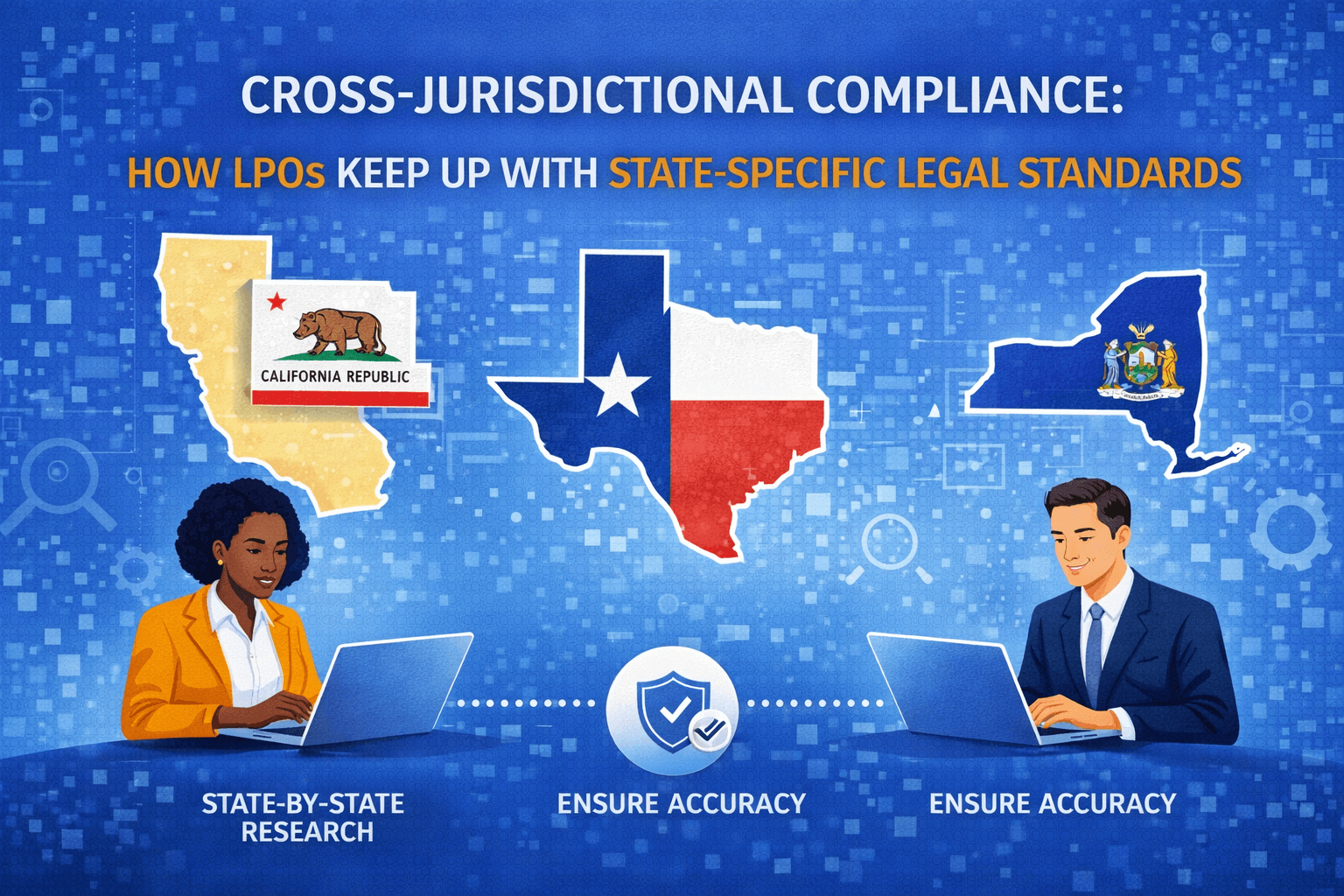
A Fragmented Legal Landscape That Demands Attention
In 2025, 19 U.S. states now have their own comprehensive data-privacy laws, each with different definitions and obligations. For individual lawyers working with LPOs (Legal Process Outsourcing providers), that means the work you outsource must be compliant not just at a federal level, but state by state. With data going offshore or across delivery centers, ensuring that legal documents adhere to every relevant jurisdiction's rules is no longer optional—it's essential.
Why Cross-Jurisdictional Compliance Is a Critical Risk
The expansion of state-level privacy legislation has indeed made compliance more complex. Several states — including Minnesota (effective July 31, 2025) and Maryland (effective October 1, 2025) — are introducing new consumer data-privacy laws that grant rights such as access, deletion, correction, and opt-out of certain data processing. Under Minnesota's law (MCDPA), consumers have the right to opt out of profiling used for automated decisions, request corrections of inaccurate data, and demand deletion of personal and sensitive data. Maryland's Online Data Privacy Act (MODPA) gives residents rights to limit data use, correct inaccuracies, opt out of the sale or sharing of personal data, and delete their data (subject to some exceptions).
Because each state's law differs in the scope and mechanics of these rights, LPOs (Legal Process Outsourcing providers) that do not maintain up-to-date, detailed regulatory-mapping systems risk producing work that is not compliant. Without such systems, there is a real possibility that an LPO's legal-document drafts or data-handling practices could fail to respect a consumer's right to correct or delete data, or to opt out where required. For lawyers who outsource work to such LPOs, this creates tangible legal and reputational exposure, especially when working on cases or projects involving personal data across multiple states.
How Leading LPOs Navigate the Complexity
To address these challenges, top-tier LPOs are combining deep legal expertise, process discipline, and technology-driven regulatory tracking.
One strong example is Mindcrest (part of DWF), which provides regulatory-mapping as a core service. They maintain a comprehensive repository of laws across more than 120 jurisdictions, supported by automated web-crawling tools and ongoing expert legal review. When regulatory updates occur, Mindcrest's system flags the changes, and their legal analysts prepare clear, client-ready summaries that map the new requirements to each client's internal policies, controls, and compliance needs.
In a real-world case, Pangea3, one of the pioneers in the LPO industry, used a Six-Sigma–driven document review process to help a client manage a major surge in litigation. In a published case study, their team reviewed more than 760,000 documents in under a month and helped the client save over $1 million through structured workflows, tiered quality checks, and continuous audit reviews. This process-first methodology—combining disciplined Six Sigma techniques with trained legal reviewers—helped maintain accuracy and consistency even when the litigation involved multiple U.S. jurisdictions.
These LPOs don't just rely on process—they also maintain governance frameworks, ensuring each piece of work is supervised by attorneys, reviewed for jurisdictional correctness, and aligned with each state's compliance requirements.
Implementing Compliance in Your Legal Practice
So how can an individual lawyer ensure that outsourcing still meets the compliance expectations required in a multi-state practice?
First, establish a clear compliance-onboarding workflow with your LPO partner. Build a shared state-specific checklist that covers privacy obligations where relevant, attorney-supervision requirements, court-rule formatting, filing conventions, and any jurisdiction-specific procedural nuances your matters involve. This gives you and your LPO a unified compliance baseline from day one.
Second, require structured regulatory awareness from your LPO. While LPOs cannot give legal advice, they can maintain an updated internal repository of state rules, court formatting standards, and statutory changes that impact drafting accuracy. This type of regulatory-mapping support helps ensure that the work product reflects current requirements, while you—as supervising attorney—retain responsibility for final legal interpretation.
Next, build periodic quality reviews into your outsourcing model. Select samples of drafted documents and compare them against applicable state rules and your internal standards. These audits help identify gaps, strengthen instructions, and tighten controls so that compliance improves over time.
Finally, make use of your LPO's technology stack. Many modern providers now use workflow platforms, change-tracking tools, and process-improvement frameworks that support consistent accuracy. When an LPO uses structured processes—such as documented quality checkpoints, review protocols, and automation for formatting or citation tasks—it reduces your risk and ensures the drafts you receive are more reliable across jurisdictions.
At Juris LPO, this compliance discipline is built into our delivery model. Our Agentic Paralegals generate precise, court-ready drafts that follow state-specific formatting, citation styles, exhibit preparation, and attorney-specific preferences. Our Human Paralegals handle substantive research, motions, pleadings, contract drafting, and final review, ensuring every document aligns with the jurisdiction's procedural rules and your professional standards. Together, they provide high-quality, well-governed work that helps prevent compliance blind spots and supports your multi-state practice with confidence.
How Leading LPOs Navigate the Complexity
To address these challenges, top-tier LPOs are combining deep legal expertise, process discipline, and technology-driven regulatory tracking.
One strong example is Mindcrest (part of DWF), which provides regulatory-mapping as a core service. They maintain a comprehensive repository of laws across more than 120 jurisdictions, supported by automated web-crawling tools and ongoing expert legal review. When regulatory updates occur, Mindcrest's system flags the changes, and their legal analysts prepare clear, client-ready summaries that map the new requirements to each client's internal policies, controls, and compliance needs.
In a real-world case, Pangea3, one of the pioneers in the LPO industry, used a Six-Sigma–driven document review process to help a client manage a major surge in litigation. In a published case study, their team reviewed more than 760,000 documents in under a month and helped the client save over $1 million through structured workflows, tiered quality checks, and continuous audit reviews. This process-first methodology—combining disciplined Six Sigma techniques with trained legal reviewers—helped maintain accuracy and consistency even when the litigation involved multiple U.S. jurisdictions.
These LPOs don't just rely on process—they also maintain governance frameworks, ensuring each piece of work is supervised by attorneys, reviewed for jurisdictional correctness, and aligned with each state's compliance requirements.
Implementing Compliance in Your Legal Practice
So how can an individual lawyer ensure that outsourcing still meets the compliance expectations required in a multi-state practice?
First, establish a clear compliance-onboarding workflow with your LPO partner. Build a shared state-specific checklist that covers privacy obligations where relevant, attorney-supervision requirements, court-rule formatting, filing conventions, and any jurisdiction-specific procedural nuances your matters involve. This gives you and your LPO a unified compliance baseline from day one.
Second, require structured regulatory awareness from your LPO. While LPOs cannot give legal advice, they can maintain an updated internal repository of state rules, court formatting standards, and statutory changes that impact drafting accuracy. This type of regulatory-mapping support helps ensure that the work product reflects current requirements, while you—as supervising attorney — retain responsibility for final legal interpretation.
Next, build periodic quality reviews into your outsourcing model. Select samples of drafted documents and compare them against applicable state rules and your internal standards. These audits help identify gaps, strengthen instructions, and tighten controls so that compliance improves over time.
Finally, make use of your LPO's technology stack. Many modern providers now use workflow platforms, change-tracking tools, and process-improvement frameworks that support consistent accuracy. When an LPO uses structured processes—such as documented quality checkpoints, review protocols, and automation for formatting or citation tasks—it reduces your risk and ensures the drafts you receive are more reliable across jurisdictions.
At Juris LPO, this compliance discipline is built into our delivery model. Our Agentic Paralegals generate precise, court-ready drafts that follow state-specific formatting, citation styles, exhibit preparation, and attorney-specific preferences. Our Human Paralegals handle substantive research, motions, pleadings, contract drafting, and final review, ensuring every document aligns with the jurisdiction's procedural rules and your professional standards. Together, they provide high-quality, well-governed work that helps prevent compliance blind spots and supports your multi-state practice with confidence.
Your Cross-Jurisdiction Compliance Toolkit
Here's a practical set of tools you can start using:
- A state-wise compliance checklist (privacy laws, court rules, UPL risk) tailored for your matters.
- A regulatory mapping framework to track which laws apply where, and how they change.
- A review protocol: periodic sample audits, feedback loops, and process improvement sessions with your LPO.
Using this toolkit helps you turn cross-jurisdictional risk into a managed, scalable part of your outsourcing strategy.
Frequently Asked Questions
Can LPOs legally help with U.S. legal work without violating bar rules?
Yes. U.S. ethics authorities allow legal outsourcing when the LPO works under proper attorney supervision and stays within support functions. Juris LPO follows this model: our Agentic Paralegals and Human Paralegals perform drafting, research, formatting, and review tasks, while all legal decisions remain with the supervising attorney.
How do LPOs stay current with 19 different state privacy laws?
Top LPOs maintain regulatory-mapping systems that track updates in state privacy requirements and court-rule changes. Juris LPO integrates these updates into workflows so that drafts, formatting, exhibits, and citations stay aligned with applicable state obligations.
Does cross-jurisdiction compliance slow down outsourcing?
Not long-term. While compliance adds structure, process-driven LPOs actually speed up delivery over time. Juris LPO uses workflow automation, template libraries, and quality-review loops so attorneys get fast, court-ready documents without sacrificing accuracy.
What's New in 2025
In 2025, key developments in state privacy law add new layers of compliance risk. Minnesota's Consumer Data Privacy Act (MCDPA) takes effect on July 31, 2025, strengthening protections around profiling, data deletion, and consumer rights. Meanwhile, Maryland's Online Data Privacy Act (MODPA) became effective on October 1, 2025, though enforcement and its obligations for data processing only begin from April 1, 2026. These changes make it more important than ever to partner with Legal Process Outsourcing (LPO) providers that have robust regulatory-mapping and audit capabilities.
Secure Your Practice with Compliance-First Outsourcing
Cross-jurisdictional compliance is no longer a “nice to have” when outsourcing legal work — it’s a core part of risk management for both you and your LPO. Choosing a provider like Juris LPO, whose Agentic and Human Paralegal teams operate with built-in compliance rigor, means you’re not just saving on cost and time — you’re protecting your practice.