
How Paralegal Support Helps Tax Attorneys During the U.S. Income Tax Filing Season
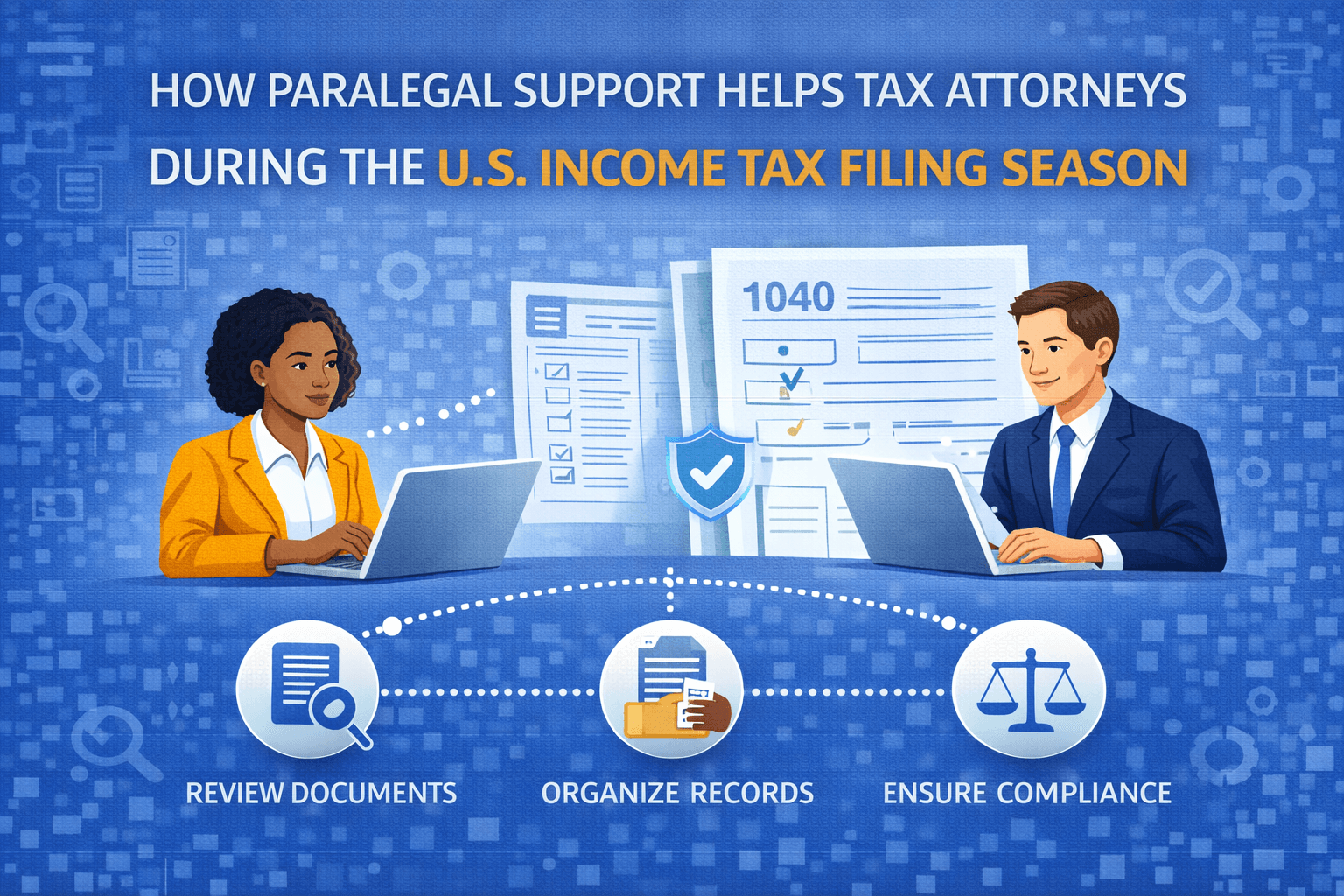
Why 2025 Tax Season Is a Turning Point for Attorneys
In 2025, the Internal Revenue Service (IRS) received approximately 140.6 million individual income tax returns and processed around 138 million of them, issuing over 86 million refunds with an average refund of about $2,942. That’s an enormous volume of work compressed into just a few hectic weeks. For tax attorneys, each return can involve complex schedules, multiple attachments, and strict compliance requirements. The scale and pressure make timely, error-free processing a formidable challenge — underscoring why dependable paralegal support for tax attorneys is no longer optional, but essential for managing workload, ensuring compliance, and maintaining client trust.
Introduction — Behind the Scenes of a High-Stakes Tax Firm
Imagine a mid-sized tax law firm in California serving real estate investors, small business owners, and high-net-worth individuals. As April approaches, clients flood the office with 1099-DIVs, K-1s, foreign asset disclosures, and late 1099-B forms. The lead attorney is swamped — balancing calculations, client calls, and case reviews — while the paperwork piles up. Behind the scenes, Agentic Paralegals from Juris LPO are hard at work: drafting precise, court- and IRS-compliant schedules, formatting tables and exhibits, cross-referencing attachments, and preparing template-ready drafts aligned with attorney preferences. Meanwhile, Human Paralegals take these drafts further, conducting legal research, reviewing citations, proofreading for accuracy, and ensuring all filings meet compliance standards. Thanks to this dual-layered support, what could easily be chaos becomes structured, deadlines are met, and clients receive accurate returns on time. For tax attorneys in today’s high-pressure environment, such support isn’t just convenient — it’s essential for survival and efficiency.
The 2025 Filing Surge and the Growing Workload for Tax Attorneys
As of the end of the 2025 filing season (April 18), the IRS had received approximately 140.6 million individual returns and processed roughly 138.1 million — issuing over 81 million direct-deposit refunds. That volume alone puts significant pressure on law firms managing multiple clients. Add to it the growing prevalence of complex filings — returns with investments, business income, multi‑state or foreign income, rental property disclosures, or amended returns — and the workload quickly becomes daunting. Paralegal support that handles document drafting, formatting, exhibits, cross-references, and compliance provides a vital buffer — enabling attorneys to focus on strategic tax planning, complex analysis, and client advisories.
That volume alone puts pressure on any law firm managing multiple clients. Add to it the growing prevalence of complex filings — returns with investments, business income, multi‑state or foreign income, rental property disclosures, or amended returns — and the workload quickly becomes daunting.
For tax attorneys, this doesn’t just mean more returns — it means entries that involve multiple schedules, attachments, disclosures and compliance checks. Mistakes or mis-formatting anywhere can lead to rejected filings, audits, or delays. Paralegal support that handles document drafting, formatting, exhibits, cross-references, and compliance provides a vital buffer — enabling attorneys to focus on strategic tax planning, complex analysis, and client advisories.
Composite Case Study: Paralegal Support in Action
A mid-size U.S. tax firm faced a surge of complex returns during the 2025 filing season, including multi-state income, rental property schedules, and foreign asset disclosures. By combining in-house and outsourced paralegal support, the firm delegated drafting, formatting, proofreading, and compliance tasks, freeing attorneys to focus on strategy and client advisories.
The result: smoother workflows, faster turnaround, reduced risk of filing errors, and lower overhead costs compared with hiring additional full-time staff. Industry reports confirm that outsourcing or augmenting paralegal support helps firms scale efficiently, maintain compliance, and improve operational productivity during peak periods.
This composite example demonstrates how strategic paralegal support enables tax attorneys to handle high-volume, high-complexity workloads without compromising accuracy or client service.
Scaling Up Smartly: Integrating Paralegal Support Into Your Tax Practice
For law firms anticipating a busy filing season, integrating paralegal services — either via in-house staff or outsourced support — can offer flexibility, efficiency, and compliance assurance without the overhead of hiring full-time associates. Begin by assessing your expected workload: number of returns, complexity levels (investment income, business returns, foreign income, etc.), and staffing capacity.
Once you've gauged demand, engage a paralegal support provider or assemble an internal team. Assign them procedural tasks: drafting returns, preparing schedules, formatting attachments, cross-referencing exhibits, applying court or IRS-mandated formatting, and proofreading documents. Meanwhile, attorneys can focus on legal review, complex tax issues, strategy, and client communication.
Set up workflows with clear hand-offs: paralegals manage the template‑ready drafts; attorneys perform final review and client sign‑off. Use document‑management systems to track versions, ensure alignment, and maintain audit trails — especially critical when managing multiple clients or amended returns. Over time, build feedback loops: gather notes on formatting errors, compliance issues, or client concerns, and feed them back to the paralegal team for continuous improvement.
By doing so, firms create a lean, efficient, scalable process — able to handle peaks (like April deadlines) without compromising quality or compliance.
Proactive Risk Management & Compliance: Avoiding Penalties and Delays
Beyond managing workload, one of the greatest values of paralegal support lies in mitigating risk. The 2025 filing season remained complex: according to the IRS, of the 140.6 million returns received, roughly 3.4 million were suspended due to errors, potential identity theft, processing rejects, or unpostable returns — nearly 2.4% of total filings. For tax attorneys, this highlights the stakes: even a missing signature, misformatted schedule, incorrect exhibit reference, or misaligned page layout can delay refunds or trigger audits.
Paralegal support addresses these challenges directly. Agentic paralegals generate precisely formatted, compliant drafts, ensuring schedules, tables, exhibits, citations, and attachments adhere to attorney-specific and IRS requirements. Human paralegals then perform final review, legal compliance checks, and proofreading, catching any subtle errors that could trigger filing suspensions. This dual-layer approach reduces the risk of rejected returns while maintaining consistency and accuracy across even the most complex filings — multi-state returns, international income, or business schedules.
By integrating paralegal teams trained on attorney-specific formatting, citation standards, and cross-referencing methods, firms not only protect clients from delays and penalties but also create a structured, reliable workflow that ensures efficiency and confidence throughout the filing season.
From Chaos to Compliance: How to Implement Paralegal Support This Season
If you’re a tax attorney or managing partner anticipating the next filing rush, here’s a practical roadmap to integrate paralegal support effectively — while aligning with services like those offered by expert providers specializing in legal‑document support.
First, assess your workload: estimate number of returns, complexity (e.g., simple W‑2 vs. multi‑state investment income or business returns), and staffing capacity. For firms expecting a surge, partnering with an experienced paralegal support provider can offer scalable assistance without the overhead of hiring full‑time staff. Outsourcing can reduce staffing‑related risks — turnover, training cost, compliance burden — while giving access to specialized expertise.
Second, define clear workflows: paralegals (or an outsourced team) handle draft preparation, organizing attachments, formatting according to IRS or court requirements, citation/style compliance, hyperlinking exhibits where needed, and proofreading. This frees attorneys to focus on legal review, client advisories, and complex tax planning.
Third, integrate feedback and continuous improvement: firms using outsourced paralegal services often report improved reliability, predictable scheduling, and flexibility — especially valuable during seasonal spikes. Over time, templates and checklists develop, streamlining the process even further and reducing turnaround times.
By embracing this model, tax firms position themselves not just to survive, but to thrive during the demanding filing season — delivering quality, compliance, and efficiency, all at reduced cost and with less stress.
Quick‑Start Toolkit for Attorneys: Paralegal Integration Guide
\To get started immediately, consider the following mini‑checklist (adaptable to your firm):
- Identify high‑volume or complex filingslikely this season (multi‑state, investment income, foreign assets, business income, etc.).
- Partner with a paralegal support providerexperienced in tax‑season demands and compliance formatting.
- Set up templates for commonly used forms, schedules, exhibits, and citations — and let paralegals pre‑populate them.
- Establish clear communication channels and feedback loopsattorneys conduct final legal review and client sign‑off.
- Design workflows where paralegals draft, format, and proofread —particularly important when handling multiple clients or returns.
- Use document‑management systems for version control, cross‑referencing, and audit trails
This toolkit aligns directly with the strengths of paralegal services: document drafting, formatting compliance, proofreading, citation/exhibit handling, and efficient workflow.
FAQs
1. Can paralegals handle sensitive parts of tax preparation?
Yes — paralegals can draft and format tax returns, organize documents, and prepare exhibits, but final review and legal opinion must remain with the attorney. This hybrid ensures compliance and ethical responsibility.
2. Will outsourcing paralegal tasks compromise quality?
Not when you partner with a reputable provider versed in tax‑season demands and court/IRS formatting requirements. Many firms report reduced error rates and improved compliance when using specialized paralegal support.
3. Is this cost‑effective compared to hiring full‑time staff?
Often yes — outsourcing avoids overhead costs (benefits, office space, training) and provides flexibility. Firms can scale up during tax season, then scale down afterward, optimizing resource use.
2025 Tax Season Reality Check: Rising Complexity and Zero-Margin for Error
The 2025 filing season saw the IRS process about 138.1 million individual returns, issuing 86.0 million refunds worth over $253.1 billion, with an average refund of around $2,942. Meanwhile, the complexity of returns is rising — spurred by increased investment activity, small business formations, and multi‑state or foreign income scenarios. That environment makes dependable paralegal support more valuable than ever. At the same time, IRS data reveals that roughly 2.4% of returns filed in 2025 were suspended for error resolution, identity‑theft safeguards, or processing rejects, potentially delaying refunds or triggering audits. For tax firms, that highlights the critical importance of precise, compliant, well‑formatted filings — exactly the area where professional paralegal support shines.
Transform Your Tax Practice Before the Next Deadline
The 2025 tax filing season underscores an inescapable truth: for tax attorneys managing high volumes, complex returns, and tight deadlines — paralegal support is not optional; it is a strategic imperative. By leveraging professional support for document drafting, formatting, compliance, and proofreading, lawyers can focus on the aspects that require their expertise: legal analysis, tax strategy, and client advisory. Meanwhile, the administrative backbone remains solid, efficient, and audit-ready.