
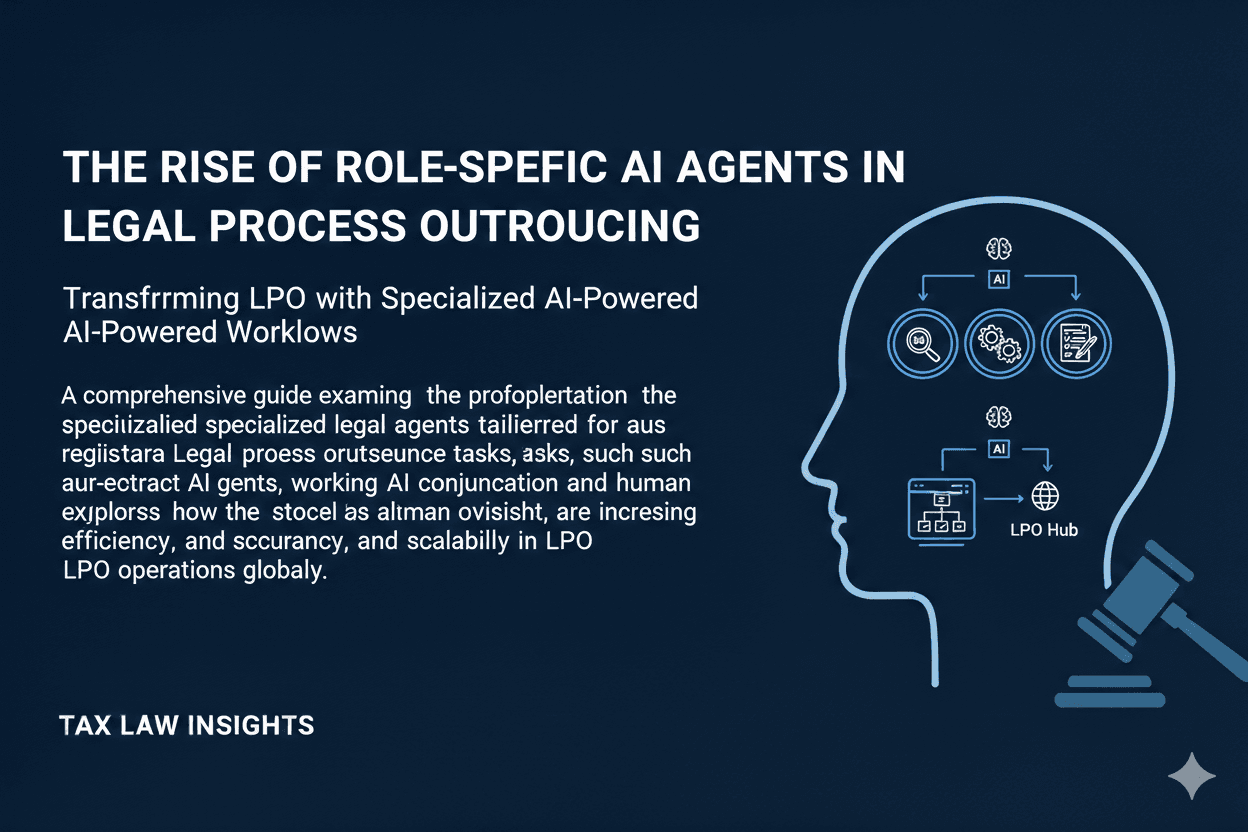
The Rise of Role-Specific AI Agents in Legal Process Outsourcing
The New Frontier of Legal Efficiency
Imagine reclaiming several weeks of productive time each year by using the right AI tools for routine legal tasks. In 2025, artificial intelligence is no longer a futuristic concept for U.S. attorneys — it is actively reshaping daily legal workflows, from legal research and document review to drafting and summarization. Recent industry studies show that AI can reduce time spent on repetitive legal tasks by 20–40 percent, allowing lawyers to redirect significant portions of their workload toward strategic thinking, client advocacy, and higher-value legal work. With this shift accelerating across law firms and solo practices alike, understanding the role of AI in legal process outsourcing (LPO) has become essential for individual lawyers who want to remain efficient, competitive, and compliant in a rapidly evolving legal market.
The AI Adoption Wave: What Lawyers Need to Know
In 2025, AI in legal process outsourcing is no longer an emerging trend — it has become a core part of modern legal operations. Recent industry reports indicate that a majority of U.S. legal professionals now use or actively test AI-enabled tools in their workflows, particularly for routine and text-intensive tasks such as document drafting, legal research, and review. Adoption is strongest where AI delivers immediate efficiency gains, helping lawyers manage growing workloads without compromising accuracy or professional standards.
The most common applications of AI in legal practice include document review, legal research, and summarization, where automation can significantly reduce time spent on repetitive groundwork. This reflects a practical reality facing today’s lawyers: clients demand faster turnaround times, predictable costs, and consistent quality, while legal professionals continue to operate under intense deadline pressure and increasing caseloads.
This environment has accelerated the rise of role-specific AI agents — specialized systems designed to handle defined legal tasks such as contract analysis, litigation support, and eDiscovery. These tools can quickly flag risks, surface relevant case law, and condense lengthy filings into actionable summaries, allowing lawyers to focus on judgment-driven and strategic work.
Importantly, these AI agents do not replace attorneys. Instead, they function as productivity multipliers. Lawyers retain full responsibility for legal analysis and decision-making, while AI handles the time-consuming preparatory work. Recognizing this shift, many large U.S. law firms have introduced structured AI training initiatives to ensure attorneys use these technologies responsibly, ethically, and in compliance with professional obligations.
How Role-Specific AI Eases Workload Pressure for Lawyers:
Lawyers routinely balance heavy workloads with tight deadlines. Role-specific AI reduces routine effort, enabling faster delivery while maintaining legal quality and control.
AI + LPO Market Momentum: What the Numbers Reveal
Artificial intelligence is no longer a speculative trend in legal practice — it is a measurable and growing force reshaping how legal services are delivered. The legal AI software market is estimated at USD 3.11 billion in 2025 and is projected to reach USD 10.82 billion by 2030, growing at a compound annual growth rate (CAGR) of 28.3%. This rapid expansion is driven by advances in natural language processing (NLP), machine learning, and predictive analytics, which enable AI tools to automate document review, contract analysis, legal research, and compliance tasks with increasing sophistication.
Adoption levels vary by firm size and practice area, but surveys indicate that a significant portion of U.S. law firms and attorneys now rely on AI tools to improve efficiency, reduce repetitive work, and maintain consistent quality across high-volume legal processes. These trends highlight a clear reality: AI‑enabled legal process outsourcing is no longer a niche innovation but a core component of modern, competitive legal operations. Lawyers who understand and integrate these technologies — whether in-house or via AI‑enhanced LPO services — are better positioned to deliver faster, accurate, and client-focused outcomes in 2025 and beyond
Summary of Strategic Advantage: Why the AI + LPO Model Wins
The combination of artificial intelligence and legal process outsourcing offers U.S. law firms a powerful model for scaling operations without increasing risk. By 2025, the most successful firms are those that use AI for high-volume technical groundwork while leveraging LPO teams for human validation and audit consistency.
- Reduced Overheads: Law firms can access enterprise-grade AI tools and specialized paralegal support without the long-term cost of in-house technology infrastructure.
- Enhanced Compliance: Layered audit workflows ensure that every AI-generated document is cross-checked for accuracy, citation validity, and court-rule adherence.
- Attorney Focus: By delegating routine drafting and research to an AI-enabled LPO partner, attorneys can focus on case strategy, client relationships, and courtroom advocacy.
- Scalability on Demand: Firms can handle sudden surges in caseloads or notice volumes by activating LPO resources that are already integrated with AI drafting pipelines.
A Real Case Study: How Specialized AI Is Delivering Results
To illustrate the practical impact of AI in legal process outsourcing, consider the growing adoption of contract-focused AI platforms such as Ivo, a San Francisco-based legal technology company founded by a former practicing lawyer. Platforms like Ivo specialize in AI-assisted contract analysis — one of the most time-intensive tasks in legal practice — and are increasingly used by in-house legal teams and law firms to support high-volume contract workflows.
These systems apply machine-learning models trained on large sets of legal agreements to identify key clauses, flag potential risks, surface inconsistencies, and suggest alternative language for attorney review. Rather than replacing legal judgment, the technology accelerates the first-pass review process, allowing lawyers to move more quickly into negotiation, strategy, and client advisory work. Firms using contract-specific AI tools report materially faster turnaround times and improved consistency across large contract portfolios.
This shift is reflected across the broader legal industry. Recent industry surveys indicate that a majority of U.S. law firms now use or actively test AI tools, particularly for contract review, document analysis, and drafting support. At the same time, continued investment in legal technology — totaling hundreds of millions of dollars annually — signals sustained confidence in AI systems that streamline high-volume legal tasks. Beyond cost efficiency, legal teams report measurable operational improvements, including reduced manual review effort and more standardized outputs when AI is integrated into LPO workflows.
Reducing Time Spent on Repetitive Contract Work
Contract review and initial drafting remain among the most repetitive and time-consuming responsibilities for lawyers. Role-specific AI agents reduce this workload by handling structured review tasks at scale, enabling attorneys to maintain compliance and accuracy while reclaiming time for higher-value legal work.
Implementing Role-Specific AI Agents Successfully
Adopting AI in legal process outsourcing requires more than simply deploying new software. It demands a thoughtful integration strategy that balances efficiency with professional responsibility, ethical obligations, and accuracy. In the United States, attorneys remain fully accountable for the work product they submit, which means AI-generated outputs must be carefully reviewed and verified, particularly when used for legal research, drafting, or court-facing documents.
A practical approach to implementation begins with focusing on high-impact, repeatable tasks such as document review, legal research, and contract analysis — areas where AI has consistently demonstrated measurable efficiency gains. However, these benefits only materialize when AI operates under clear human supervision. Recent U.S. court actions involving sanctions for unverified AI-generated citations have reinforced an important lesson: AI can assist legal work, but it cannot replace professional judgment or diligence.
Successful adoption also requires ongoing education. Many large U.S. law firms have introduced structured AI training initiatives to ensure attorneys understand both the capabilities and limitations of these tools. For solo practitioners and small firms, this same principle applies — lawyers must stay informed about responsible AI use and incorporate verification steps into their daily workflows. Integrating AI agents into existing practice management and document systems further ensures that AI insights are immediately actionable rather than disruptive.
Looking ahead, the role of AI in LPO will continue to expand as technology matures. Specialized AI agents will increasingly support functions ranging from legal intake to document automation, while lawyers focus on advocacy, analysis, and client counseling — the areas where human expertise remains indispensable.
Balancing Speed, Accuracy, and Ethical Compliance
Law firms and solo practitioners alike face constant pressure to deliver faster results without sacrificing accuracy or ethical standards. A structured AI implementation strategy allows lawyers to enhance efficiency while maintaining full control over legal quality and professional responsibility.
Actionable Toolkits for Lawyers
To help individual lawyers apply AI in legal process outsourcing in a practical and controlled way, a structured toolkit can make implementation far more effective. A foundational starting point is an AI integration checklist that maps legal tasks most suitable for AI assistance, such as document review, contract analysis, and legal research. This task-mapping step helps lawyers focus AI use where efficiency gains are most measurable, rather than applying technology indiscriminately.
Equally important is a verification protocol that outlines clear steps for reviewing AI-generated outputs for accuracy, formatting, and compliance with professional responsibility obligations. In the U.S. legal environment, attorneys remain accountable for all work products, making systematic review essential when AI is involved. Alongside this, an AI vendor evaluation framework enables lawyers to assess tools based on reliability, data security, confidentiality safeguards, and alignment with legal ethics requirements.
A simple quick-start strategy further supports adoption. Lawyers should begin with limited pilot use cases, standardize human review checkpoints in their workflows, and ensure they stay informed about ethical and secure AI use — whether practicing solo or within a firm. Together, these tools allow lawyers to gain immediate value from AI while preserving legal quality, regulatory compliance, and client trust.
FAQs
1. Can AI replace lawyers in legal process outsourcing?
No. AI is designed to automate repetitive and structured tasks, but legal judgment, ethical responsibility, and strategic decision-making remain exclusively human functions. In LPO, AI supports lawyers by improving efficiency — it does not replace professional accountability or legal expertise.
2. Is AI legally compliant for court drafting?
AI-generated drafts can be used as support tools, but they must always be reviewed and verified by an attorney before submission. U.S. courts have made it clear that lawyers remain responsible for accuracy and compliance, and unverified AI-generated content can result in sanctions.
3. What legal tasks should lawyers automate first?
Lawyers typically see the greatest benefit by starting with high-volume, routine workflows such as document review, legal research, and summarization. These tasks offer immediate efficiency gains while remaining easy to supervise and validate.
Regulatory Developments Shaping Ethical AI Use in Law
In 2025, the American Bar Association and several U.S. state bar associations continue to issue and update guidance on the ethical use of artificial intelligence in legal practice. This guidance consistently emphasizes attorney responsibility for verifying AI-generated outputs, maintaining confidentiality, and implementing appropriate data-security safeguards when using AI tools. Lawyers are also encouraged to document oversight and review processes, particularly when relying on external or third-party AI systems. These developments underscore the importance of responsible AI adoption as legal process outsourcing workflows become increasingly technology-enabled.
Looking Ahead: The Future of AI-Enabled Legal Support
Role-specific AI agents are steadily transforming AI in legal process outsourcing, giving lawyers practical tools to manage growing workloads, improve consistency, and focus on higher-value legal work. When implemented responsibly, these technologies enhance — rather than replace — professional judgment, allowing attorneys to deliver efficient, accurate, and client-focused outcomes in an increasingly demanding legal environment.
As AI adoption continues to evolve across U.S. legal practice, understanding how to evaluate, integrate, and supervise these tools will become an essential professional skill.