
Training AI to Think Like a Paralegal: The New Frontier in Legal Tech
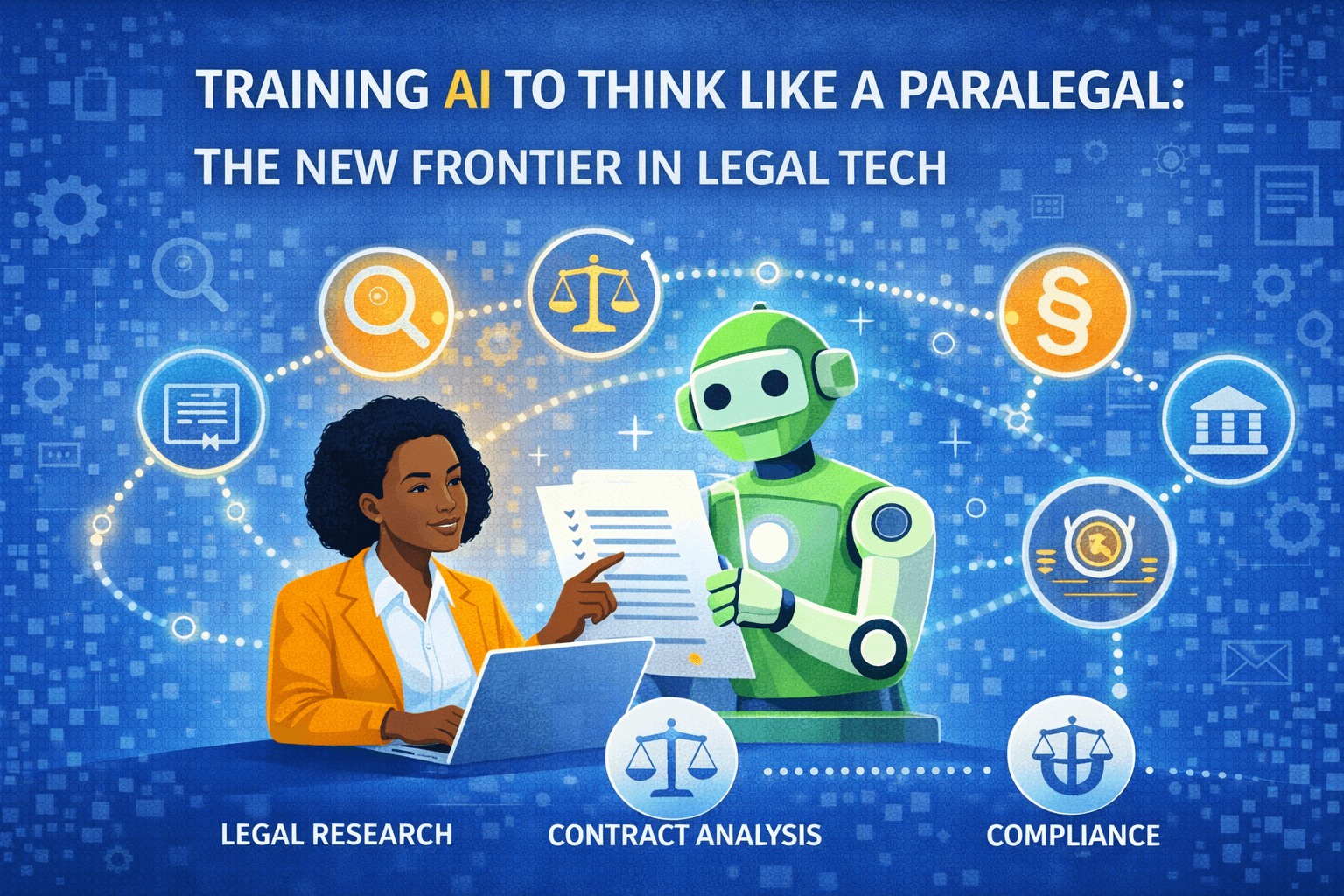
From Weeks to Days: The Legal AI Inflection Point
As AI tools increasingly permeate legal workflows, some firms are reporting turnaround times for document review shrinking dramatically—from weeks to just a few days—after adopting generative-AI assistants. Meanwhile, the legal-AI market is scaling fast: in 2024, it was valued at around USD 1.45 billion globally. And the broader legal-technology market itself is projected to hit USD 31.6 billion in 2024, growing rapidly from there. For individual lawyers, the message is clear: begin training AI for legal work now — or risk falling behind.
Why "Thinking Like a Paralegal" Matters
Paralegals handle critical foundational work in legal practices: legal research, drafting, managing citations, and formatting for court compliance. Training AI to replicate those workflows—by leveraging jurisdiction-specific rules, citation styles, and attorney-preferred formats—can free lawyers to focus on higher-value tasks like strategy and client counseling. Legal aid organizations provide a compelling proof point: with Thomson Reuters’ CoCounsel, some nonprofits are saving up to 75% of the time on urgent case-preparation, while legal-hotline teams are responding to twice as many calls, and attorneys report saving as much as 15 hours per week.
From Weeks to Days: The Legal AI Inflection Point
As AI tools increasingly permeate legal workflows, some firms are reporting turnaround times for document review shrinking dramatically—from weeks to just a few days—after adopting generative-AI assistants. Meanwhile, the legal-AI market is scaling fast: in 2024, it was valued at around USD 1.45 billion globally. And the broader legal-technology market itself is projected to hit USD 31.6 billion in 2024, growing rapidly from there. For individual lawyers, the message is clear: begin training AI for legal work now — or risk falling behind.
Why "Thinking Like a Paralegal" Matters
Paralegals handle critical foundational work in legal practices: legal research, drafting, managing citations, and formatting for court compliance. Training AI to replicate those workflows—by leveraging jurisdiction-specific rules, citation styles, and attorney-preferred formats—can free lawyers to focus on higher-value tasks like strategy and client counseling. Legal aid organizations provide a compelling proof point: with Thomson Reuters’ CoCounsel, some nonprofits are saving up to 75% of the time on urgent case-preparation, while legal-hotline teams are responding to twice as many calls, and attorneys report saving as much as 15 hours per week.
What "Training" Looks Like: A Real Case Study
Training AI for legal work involves rigorous curation, fine-tuning, and supervision — not just "turning it on." Firms begin by feeding the system with a trusted set of materials (statutes, case law, firm templates) and then build training examples to closely mimic the tasks they want the AI to do. Then they evaluate performance carefully, often comparing outputs against human baseline work.
Dykema, a national U.S. law firm, is one of the most concrete examples: the firm publicly announced its adoption of Casetext's CoCounsel, powered by GPT-4, to handle tasks such as legal research, e-discovery, contract review, summarization, and data extraction. Their rollout included extensive testing — over 4,000 hours of training/coaching — before full deployment.
On the nonprofit side, Thomson Reuters' AI for Justice program shows how CoCounsel can scale legal aid: participating attorneys report saving up to 15 hours a week and cutting urgent case-preparation time by 75%, while handling more client calls and legal tasks.
Key lessons from these deployments include:
- Use trusted legal-data sources (e.g., Westlaw, Practical Law) so that the AI's reasoning is based on real, authoritative law.
- Keep humans in the loop — attorneys review and verify AI-generated outputs to catch nuance, edge cases, or format issues.
- Monitor and refine performance over time — by logging prompts, outputs, and user feedback, organizations can continuously improve accuracy and reliability.
This hybrid approach (AI-generated first drafts + human review) enables scalable, high-quality output— letting lawyers and legal teams focus more on strategy, client work, and higher-level legal thinking, while relying on the AI system for the more repetitive, time-consuming tasks.
Juris LPO’s AI + Human Paralegal Workflow
Juris LPO leverages a two-tier model to make AI training both practical and reliable. In the first tier, Agentic Paralegals generate precise, court-compliant drafts that align with attorney and court rules. They automate repetitive tasks such as formatting, citations, tables, exhibits, and hyperlinking, producing template-ready drafts that can be immediately reviewed by humans. In the second tier, Human Paralegals perform substantive legal tasks, including research, drafting motions, contracts, and pleadings. They ensure compliance with attorney-specific nuances, Bluebook citations, and court formatting while reviewing AI outputs for accuracy, style, and legal completeness. This hybrid workflow mirrors the approach described in earlier sections, giving lawyers scalable, high-quality output while preserving professional responsibility.
Juris LPO’s AI + Human Paralegal Workflow
Juris LPO leverages a two-tier model to make AI training both practical and reliable. In the first tier, Agentic Paralegals generate precise, court-compliant drafts that align with attorney and court rules. They automate repetitive tasks such as formatting, citations, tables, exhibits, and hyperlinking, producing template-ready drafts that can be immediately reviewed by humans. In the second tier, Human Paralegals perform substantive legal tasks, including research, drafting motions, contracts, and pleadings. They ensure compliance with attorney-specific nuances, Bluebook citations, and court formatting while reviewing AI outputs for accuracy, style, and legal completeness. This hybrid workflow mirrors the approach described in earlier sections, giving lawyers scalable, high-quality output while preserving professional responsibility.
How to Implement Quickly and Safely
Begin with a pilot: choose a repeatable workflow such as initial motion drafting or contract redlining, define your inputs/outputs, and set success metrics like accuracy and time saved. When selecting AI tools, favor those that provide transparency into their sources and support secure handling of data. You should also design governance and supervisory controls in line with professional-responsibility guidance: for example, ABA Formal Opinion 512 requires lawyers to maintain competence, preserve client confidentiality, and supervise AI usage carefully.
Expect challenges like hallucinations, data leakage, or compliance risk. Mitigate them by restricting sensitive client information, enforcing access controls, and mandating human review and sign-off on any AI-generated content before it’s used in client work or filed with a court. Supervisory lawyers should also establish clear firm policies on AI use per Model Rules 5.1 / 5.3.
One practical model: have a first-line “AI paralegal” (the AI tool) generate drafts, and then have a human paralegal or attorney review for legal substance, Bluebook citations, linking exhibits, proofreading, and compliance with court rules. This layered approach helps maintain professional responsibility while enabling efficiency.
Quick Implementation Toolkit
A simple, step-by-step approach to deploy AI safely and effectively in legal workflows. Focus on accuracy, security, and human oversight to maximize efficiency and compliance.
- Identify a Pilot Workflow: Start with one repeatable task, such as drafting motions or reviewing contracts. Focus on mapping inputs, outputs, and clear success metrics.
- Use Trusted Legal Sources: Feed the AI only statutes, firm templates, and verified precedent. This ensures accuracy, proper citations, and court-compliant outputs.
- Choose a Secure AI Tool: Pick systems that protect client data and provide transparency on sources. Avoid tools that train on confidential documents without control.
- Maintain Human Review: Always have a paralegal or attorney review AI-generated drafts. Track edits, ensure compliance, and use feedback to improve accuracy.
FAQs
Q1. Can AI replace paralegals?
No—AI automates routine tasks but human paralegals remain essential for legal judgment, complex research, and final compliance; hybrid workflows outperform pure automation.
Q2. Are AI-generated drafts admissible or court-safe?
Courts care about accuracy and candor. Always verify citations and preserve source chains; ABA guidance requires competence and supervision when using AI.
Q3. How fast can firms see ROI?
Pilots often show measurable time savings within weeks; ALSP adoption and market data indicate rapid efficiency gains when governance is in place.
Key Regulatory Developments in AI for Legal Work
Major developments in 2024–2025 are shaping how lawyers can safely adopt AI. The ABA issued Formal Opinion 512 on July 29, 2024, providing guidance on generative AI use, emphasizing lawyer competence, confidentiality, and supervision. The FTC launched “Operation AI Comply” in 2024 to enforce rules against deceptive AI claims and ensure transparency in AI-powered products. Meanwhile, NIST published its Generative AI Profile as part of the AI Risk Management Framework in July 2024, offering guidance on managing risks unique to generative AI, including accuracy, provenance, and secure data handling. Together, these updates set clear expectations for ethical, compliant, and secure AI deployment in legal workflows.
Get Started: Launch Your First AI Pilot Today
Train your first AI pilot around a single paralegal workflow this quarter—whether it’s drafting motions, reviewing contracts, or preparing discovery summaries. Measure performance, iterate based on feedback, and ensure humans remain in the loop to verify accuracy and compliance. By starting small, you can build confidence, refine processes, and gradually scale AI adoption across your practice without compromising professional responsibility.